As computing demands keep rising and AI-driven workloads are reshaping infrastructure requirements at an unprecedented pace, data center operators are under growing pressure to manage data center power usage in smarter and more adaptable ways. Introducing new racks and cooling units only adds to an already significant energy footprint, making consolidation and efficiency both a technical and financial priority.
Fortunately, there are multiple paths toward smarter data center energy use. Airflow management, advanced liquid cooling, and several other methods targeting data centers’ power optimization now span a range of strategies suited to facilities of all sizes. The challenge is identifying which methods deliver the greatest return for your specific environment. Some approaches offer quick, low-cost improvements, while others require long-term investment but, in turn, yield dramatic efficiency gains.
This article outlines why power optimization is a non-negotiable today, and offers a glimpse into proven approaches to data centers power optimization. These methods offer a practical roadmap for data center power optimization that strengthens performance, reduces waste, and supports sustainability goals at the same time. Let’s dive in!
Why Data Center Power Optimization is Becoming a Necessity
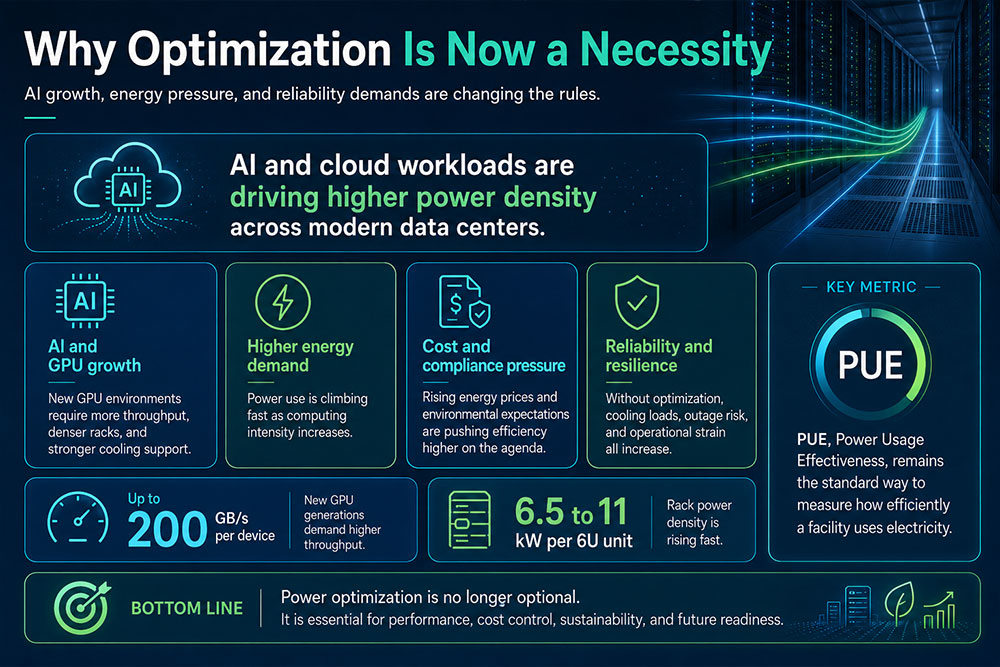
Artificial intelligence and cloud computing are immutably redefining how energy is used in modern data center facilities. Machine learning applications are not only data-hungry but exceptionally power-hungry too, requiring advanced cooling systems and massive bandwidth capacity. New generations of GPUs demand higher and higher throughput (up to 200 GB/s per device) and greater power density as well, with racks consuming from 6.5 to 11 kW per 6U unit. These demands are reshaping infrastructure planning and pushing the importance of efficient data centers power optimization strategies.
Data centers already consume around 1 percent of all electricity globally, and projections suggest that number could double to 35 gigawatts annually by 2030. Such a fast and unpredictable growth makes data centers power optimization a priority. Without efficiency improvements, operators face not only rising energy bills, but heavier cooling loads, and higher risks of redundancy-related outages as well. In the meantime, higher energy prices and environmental regulations are urging the shift toward sustainable solutions. Power Usage Effectiveness (PUE) has become a key benchmark for measuring how efficiently data centers use electricity.
There’s a quickly growing need for data centers with designs capable of integrating renewables, dynamic cooling systems, and approaches like intelligent load balancing, which help to reduce waste and emissions. Through a more ample approach to data centers power optimization, operators can improve reliability and reduce the costs of operation, while also aligning with global sustainability commitments. Data centers power optimization is ultimately serving the purpose of securing operational resilience, allowing operators to handle the increasingly dense AI workloads with predictable performance, stable PUE, and respecting compliance and sustainability standards.
Where Does All the Energy Go?
When tracking energy use inside a data center facility, it becomes clear that power demand extends far beyond the IT racks.
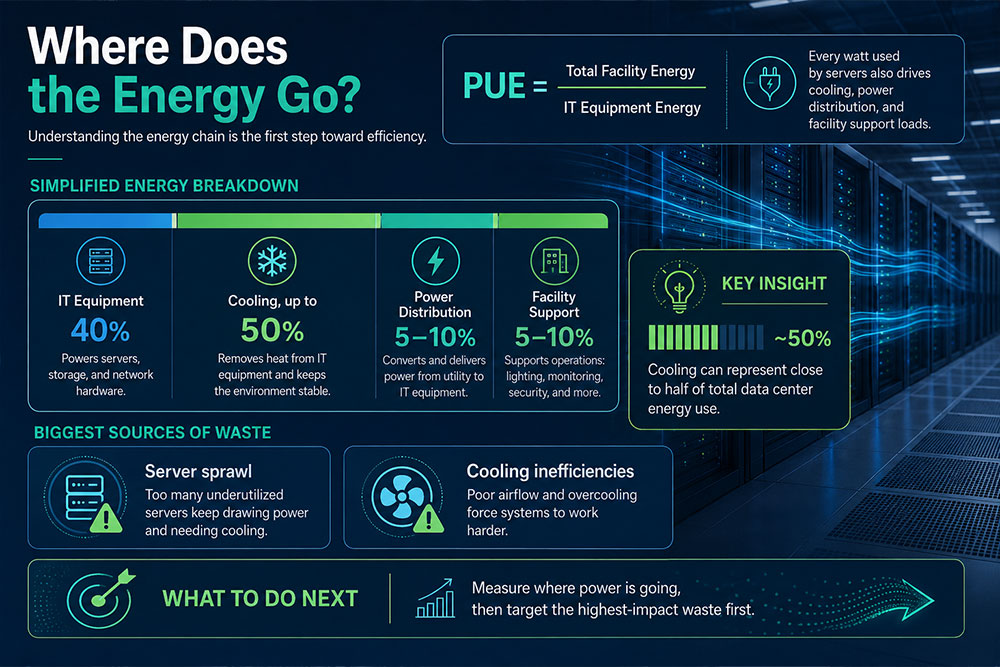
The PUE metric reflects this balance, comparing total energy use against what’s actually consumed by computing equipment. Every watt spent on servers requires additional watts for cooling, power distribution, and facility support. In many data centers, cooling alone can represent close to half of total energy consumption. Recognizing where energy goes is the first step toward improvement through data centers power optimization. Two areas typically account for the largest share of waste: server sprawl and cooling inefficiencies.
Server Sprawl
Server sprawl is a term for describing what happens when data centers maintain more hardware than necessary for their current workloads. Underutilized servers still draw power, need cooling, and occupy valuable rack space, even if their compute output is minimal. This can happen for several reasons: deploying too many second-tier servers, dedicating machines to single applications, or failing to decommission outdated equipment. These can result in a steady drain on resources that drives up both energy and maintenance costs. Data centers power optimization targets this side of energy consumption, offering solutions to reduce the waste. Unmanaged server sprawl quickly turns into operational overhead: each extra server adds to monitoring complexity, the risk of network congestion, and performance bottlenecks. Left unchecked, it also raises the facility’s baseline power demand, skewing PUE scores and masking true efficiency levels.
The most effective solution is data center consolidation. Consolidation initiatives often go hand in hand with modernization projects, allowing operators to migrate workloads to more up-to-date and efficient systems. By reducing the number of legacy servers (or replacing them entirely with high-density, energy-efficient hardware), operators can drastically cut energy waste and cooling requirements. These efforts also align with broader sustainability goals, helping facilities lower both their carbon footprint and real-estate costs.
Moreover, modernization provides a secondary benefit: future-readiness. Consolidated infrastructures are better equipped to integrate AI workloads and high-performance computing, which require denser power and cooling designs.
Cooling Inefficiencies
After computing equipment, cooling is the most power-intensive function in any data center. Because PUE accounts for the total facility load, cooling can easily represent up to 50% of overall power consumption. Data centers power optimization, therefore, continues with cooling, one of the most direct ways to improve, or more accurately, reduce PUE.
Inefficient cooling practices often stem from design oversights and outdated management habits. Maintaining a uniform temperature across the entire data hall, for instance, often leads to overcooling large areas that don’t actually need it. Poor airflow management compounds the problem by failing to deliver cold air where it’s needed most. Misplaced racks, blocked vents, or equipment positioned without considering intake and exhaust flow can all create hot spots that force systems to work harder.
Without proper containment, warm and cool air mix freely, which quickly undermines cooling efficiency. The system then compensates by consuming even more energy to maintain target temperatures. Over time, this vicious cycle raises operational costs, increases equipment strain, and inflates PUE ratios.
Addressing cooling inefficiencies and data centers power optimization starts with assessment: tracking airflow, thermal loads, and equipment placement. Even small changes, like improved hot-aisle/cold-aisle containment or blanking panels to prevent air recirculation, can make significant and measurable differences. These optimizations are the first steps toward advanced strategies like direct-to-chip or liquid immersion cooling, which can dramatically cut energy use and help maintain stable thermal conditions throughout the facility.
How Data Centers Power Optimization Strategies Go Hand in Hand With Sustainability Goals
In today’s market, data centers are expected to be transparent about exactly how efficiently they operate. Customers want to see the numbers, and sustainability reports are becoming part of service expectations. Statistically, around one in five clients already require their data center provider to demonstrate clear sustainability practices, and that share keeps growing. Within the facility, real-time visibility into energy use has become essential, allowing operators to understand how power is distributed, where it’s wasted, and how efficiency can be improved. For many facilities, this transparency is now central to data centers power optimization.
Modern operations rely on Data Center Infrastructure Management (DCIM) platforms and continuous power monitoring systems to collect detailed data from every point along the energy chain. These tools capture equipment-level loads and reveal how layout, airflow, or cooling adjustments can improve overall performance. With this insight, operators can fine-tune power distribution and cooling balance to reach better PUE scores.
On the other end, customers increasingly expect to have access to this data as well. Shared dashboards and energy reports let providers and clients track the progress toward sustainability goals, renewable integration, and power efficiency benchmarks. In this way, data centers power optimization supports not only internal efficiency, but accountability and collaboration, too. Transparent metrics make sustainability measurable and credible, turning energy awareness into a routine part of daily operations that is transparent to all parties involved.
Methods of Reducing Energy Waste in the Data Center
Energy efficiency begins with understanding how every subsystem contributes to total power draw, and where that energy can be saved.
Some approaches, like improving airflow management or consolidating servers, require minimal investment but yield immediate results. Others, like advanced cooling technologies, for instance, require higher upfront costs but result in more substantial long-term benefits.
The success of data centers power optimization depends on finding the perfect balance between infrastructure upgrades and smart operations. Power monitoring, airflow containment, and liquid cooling systems play complementary roles in this process. Combining these methods allows operators to lower both operational expenses and environmental impact, and, what’s often overlooked, extend the lifespan of their critical infrastructure.
Server Consolidation
One of the most straightforward ways to reduce power consumption in a data center is to run fewer servers. Even when total compute capacity stays the same, one modern, high-performance server typically consumes less electricity than multiple smaller ones handling the same workloads. Consolidating workloads onto a smaller number of efficient systems directly reduces energy use, cooling demand, and overall maintenance requirements.
Server consolidation is one of the most practical steps toward data centers power optimization because it improves the ratio between energy consumed and computing output. By migrating workloads from underutilized machines to more capable ones, operators can maintain performance levels by decommissioning excess equipment. This reduces power draw, as well as the complexity of managing idle or outdated hardware.
The process rarely requires a major investment. Often, it’s just about reorganizing existing resources instead of buying new ones. Although some staff time is needed to plan and execute migrations, the savings quickly outweigh the effort. In most cases, organizations can also resell or repurpose retired equipment. Under growing energy and sustainability pressures, this is one of the simplest yet most effective steps toward long-term efficiency gains in the data center.
Power Usage Monitoring
Understanding exactly how power is consumed across a facility is the very foundation of smart energy management. Without access to accurate data, operators are essentially just guessing where the inefficiencies lie. Power monitoring tools can offer the visibility needed to pinpoint high-consumption servers and overloaded circuits, or identify any issues related to equipment that’s no longer performing efficiently. These issues can quietly inflate costs and risks in the background, unnoticed, so tracking them down can be crucial.
When integrated with data centers power optimization efforts, monitoring systems can turn raw data into actionable insights. Operators can track usage trends, detect anomalies in real time, and make data-based, informed decisions about workload distribution and equipment maintenance. They also offer early warnings about potential reliability problems (for example, power feeds approaching capacity limits)
Power metering solutions typically require a modest investment. Many DCIM platforms already include power monitoring capabilities. Dedicated hardware meters deliver higher precision for a minimal additional cost. The result is a more transparent, predictable energy profile and a stronger foundation for ongoing efficiency improvements.
Hot and Cold Aisle Containment
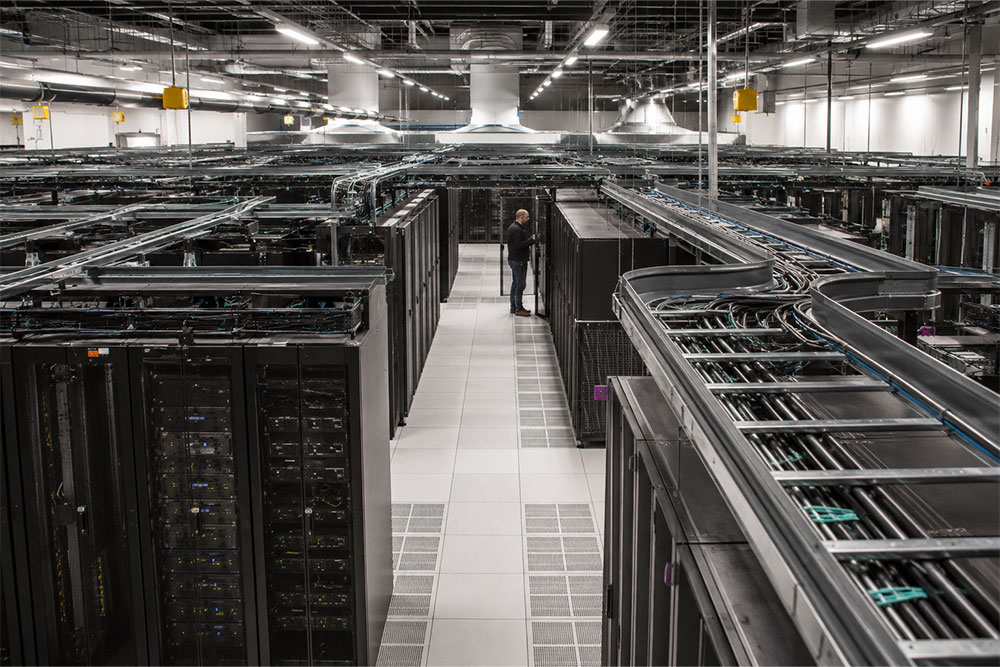
One of the simplest and most cost-effective ways to reduce energy waste is to improve airflow management. Hot and cold aisle containment separates warm and cool air inside the data hall, ensuring that each stream moves efficiently without mixing. Positioning servers front-to-front and back-to-back, helping cool air flow into the intake, while hot air is expelling into designated aisles. Cooling systems can then target those hot zones directly instead of treating the entire room.
This approach offers quick results in data centers power optimization. It doesn’t require new hardware or additional floor space, yet it can cut cooling energy use by as much as 30–35 percent. Better airflow also keeps rack temperatures consistent, preventing hotspots and extending equipment lifespan. As part of broader data centers power optimization strategies, aisle containment remains one of the easiest upgrades to implement with immediate and measurable impact.
Direct to Chip Cooling
No wonder that next-generation thermal technologies are drawing so much attention: cooling is still one of the weakest points in data centers power optimization strategies. Direct-to-chip cooling takes a more precise approach than traditional air systems by circulating liquid coolant directly over the components that generate the most heat: CPUs, GPUs, and memory modules. Extracting heat at the source lets the system work more efficiently by eliminating the need to chill large volumes of air.
When considering data centers power optimization, direct-to-chip cooling can be a significant long-term investment. Installation costs can reach $5,000 or more per rack, however, the long-term savings in power and maintenance typically outweigh these upfront expenses. The result is worth it: a cooler, more stable environment that supports higher rack densities, reduces energy waste, and positions the facility for the demands of modern high-performance computing.
Immersion Cooling
When it comes to efficiency beyond conventional limits, immersion cooling offers one of the most advanced thermal management methods available.
How does it work? Instead of relying on air or liquid lines touching specific components, entire servers are submerged in a dielectric, non-conductive fluid that absorbs and transfers heat instantly. Heat is removed directly from every surface, dramatically improving cooling performance. Fans can often be eliminated altogether, reducing both power use and noise pollution.
Implementation costs are high (studies estimate installation at around $25,000 per rack), but the operational benefits are impressive. Energy consumption drops sharply, thermal stability is easier to maintain, and rack density can increase without the risk of overheating. For high-performance or AI workloads, immersion cooling can be the way to go for organizations willing to invest more for substantial improvement. As part of broader data centers power optimization strategies, it represents a bold but highly effective step toward future-ready, sustainable operations.
Power Optimization Strategies That Work for You
The strategies described in this article provide operators with a clear framework for improving efficiency, moving from quick, low-cost adjustments to more significant infrastructure upgrades. Data centers power optimization can start with incremental steps like hot and cold aisle containment or server consolidation, which deliver immediate savings and help establish measurable performance baselines. Once these fundamentals are in place, operators can plan the next phase, introducing advanced technologies like direct-to-chip and immersion cooling to unlock deeper efficiency gains. The process doesn’t need to be disruptive; it’s about slowly aligning each improvement with operational goals and the available budget. Improvements can start with simple things, and then gradually build towards the more complex solutions that necessitate bigger investments. The key to progress is setting goals that align with your current possibilities, and gradually but consistently moving towards the improvements that lead to lower power consumption and better performance.