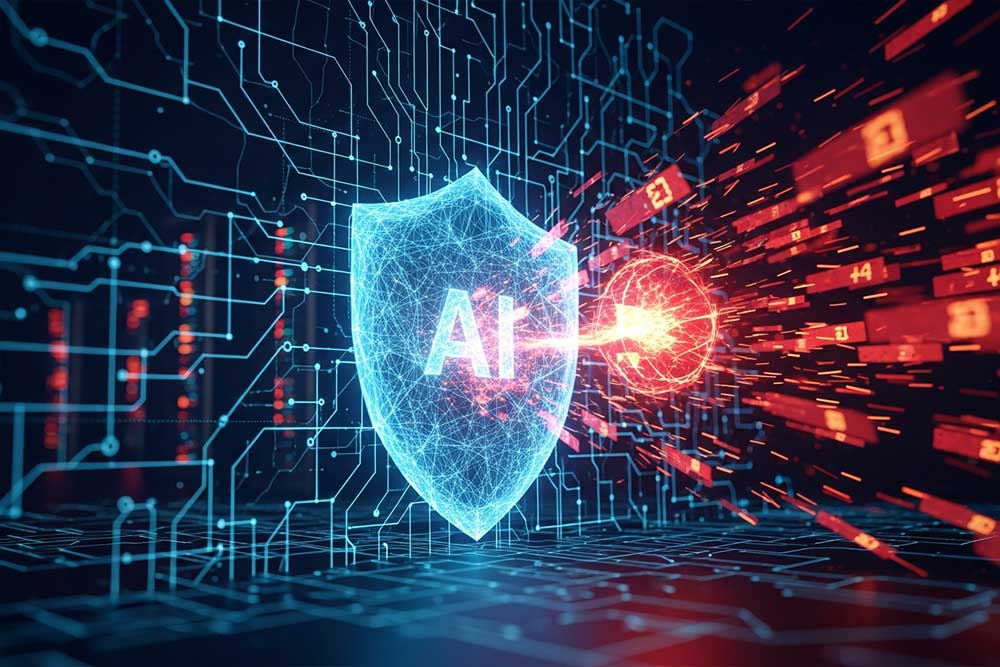
Distributed Denial of Service (DDoS) attacks remain one of the most disruptive threats to IT infrastructure. They flood systems with traffic, degrade performance, and can take critical services offline. With the rise of AI, attackers now have scarily efficient tools to plan and execute these operations – but so do organizations to protect themselves against these attacks by using AI in DDoS defense.
Organizations that fail to harden their infrastructure effectively can become easy targets. Relying on static defenses is no longer enough. Attackers are continuously refining their tactics with AI and identifying weak points faster than many security teams are able to respond.
Because of this, fighting fire with fire can become a lifesaver: AI in DDoS defense can serve as the lifeblood of a modern security strategy. It can be used to analyze traffic in real time, establish baselines for normal behavior, and detect anomalies that could indicate an attack in progress. Offensive use of AI is becoming so widespread that leveraging the same class of technology for defense is proportionately necessary to keep systems resilient and protect critical services.
In this blog, we are going to dive once again into the dark world of infrastructure threats, and specifically, DDoS attacks. We will unpack how they work, how the rise of AI has changed everything, and what organizations can do to counteract it by using AI in DDoS defense.
What Is a DDoS Attack?
Before getting to how AI in DDoS Defense can work wonders against attacks, let’s take a quick look at how DDoS attacks actually work.
A Distributed Denial of Service (DDoS) attack works like this: attackers use large groups of compromised devices to overload a target’s digital systems. This is called a botnet, and the attack is carried out by bombarding websites or applications with so much traffic that they can no longer respond to the requests of real users. For example, if a company runs an outdated web server, a DDoS campaign could quickly make the site unreachable.
Why is DDoS so effective? Because of its scale. A basic denial-of-service attack comes from a single machine and can usually be blocked. DDoS, on the other hand, hits from thousands of sources at once, making it far harder to detect, filter, or trace back.
The goal is simple: to disrupt availability. When services are down, everyone, including customers, employees, and partners, loses access. Even if attackers only target one weak point, the overflow of malicious traffic can ripple outward and take down an entire network. An incident like this can cost a lot of money and resources for everyone involved, and dangerously distract security teams from addressing other threats that may be forthcoming.

The Bad Guys Behind DDoS Attacks
DDoS defense in a pre-AI sense is based on a set of on-prem tools like cloud-based scrubbing services, traffic filtering on the ISP-level, and rate limiting. These methods have been widely used to detect and stop threats from reaching critical infrastructures. But because modern DDoS attacks work by merging with legitimate traffic, these legacy methods are not enough to filter out today’s adaptive DDoS campaigns. This, again, emphasizes the importance of AI in DDoS defense.
Who launches a DDoS attack? It can be anyone from someone paid to do so, someone with political or competitive reasons, or just an ill-willed person behind a computer. Similar to RaaS (Ransomware as a Service), there are online services today that allow actors to buy DDoS with Bitcoin and direct it at any organization they want. And as AI tools are gaining traction, DDoS activity is seeing a surge. People behind attacks don’t need to venture to the dark web and pay a real hacker to find weaknesses and penetrate an organization, because they can do this with a little help from AI tools.
One more reason for organizations that want to protect themselves is to use AI in DDoS defense strategies.
E-commerce platforms, SaaS providers, colocation data centers, and other enterprises that deliver high-availability applications are vulnerable to DDoS attacks, which can be fatal. Technical challenges put aside, these can draw serious financial penalties for not respecting compliance requirements and SLAs, destroy the company’s image, and impact customer trust.
How AI in a DDoS Attack Works
Machine learning models can quickly identify unpatched systems, misconfigured services, or other weaknesses in exposed infrastructure, making it easier for attackers to find victims. Once the vulnerabilities have been detected, cyber criminals can initiate botnets very fast and optimize traffic patterns to bypass conventional detection methods. The result is a faster, more targeted, and more persistent DDoS activity.
Adaptive algorithms can help distinguish between legitimate usage spikes and coordinated malicious traffic, reducing false positives and enabling quicker responses. However, integrating AI in DDoS defense doesn’t replace human oversight as many might think, but it improves visibility and makes detection and mitigation faster.
How AI in DDoS Defense Works
The good news is that just like threat actors, who can use the power of AI to launch an attack, organizations can use AI in DDoS defense. AI is the perfect tool for identifying anomalies in network behaviour, detecting vulnerabilities that can be missed by traditional scans, and allowing for a more targeted mitigation.
AI in DDoS defense can be a really precious tool: machine learning algorithms can process huge volumes of traffic data in real time to detect unusual patterns that indicate DDoS events. This allows for much faster detection than with traditional tools. When integrated into security platforms, AI has the ability to adapt and face new threats. By learning the unique traffic patterns an organisation has, AI can reduce the number of false positives, reduce testing errors, and thus protect the enterprise.
AI in DDoS defense can be applied to detection and response processes as well. So, instead of wasting resources by having an engineer look at logs for threats, AI can be trained to detect threats and apply an automated mitigation and remediation response immediately.
With AI built into the threat mitigation platform, companies are able to monitor and respond to new attacks very fast. And time is maybe the most crucial factor of them all. So, just as it can assist cybercriminals, AI in DDoS defense can serve as a helping hand for security experts as well.
Protecting Yourself Against DDoS Attacks
DDoS attacks have evolved into one of the most persistent challenges for organizations that depend on reliable digital services. What makes DDoS attacks so powerful is their ability to overwhelm systems so quickly. Attacks often blend in with legitimate traffic, efficiently targeting critical applications or infrastructure. Traditional defense strategies alone are no longer enough, raising the need to use AI in DDoS defense, especially as attackers adopt automated and AI-driven tools that allow them to scale and adapt in real time.
Protecting against DDoS calls for a multi-layered approach: preventive measures, adaptive technologies, and sound operational practices that keep services available even under an unfolding attack. The goal is to block malicious traffic and maintain continuity for legitimate users during the attack.
Every single organization’s strategy will look different depending on the size of its infrastructure, the type of services it delivers, and the regulatory compliance requirements or SLAs it has to meet.
In the following sections, we will look at practical approaches to DDoS defense and best practices for keeping assets safe.
Best Practices for Securing Your Assets
DDoS protection strategies start with insulating your assets and understanding which systems matter most.
Not all workloads have the same level of criticality, so, as a first step, organizations have to identify their high-value applications and services, the ones for which uptime is the most critical. Prioritizing ensures that resources are allocated efficiently and that protection efforts align with business goals as well.
With priorities established, the next step is building a layered defense. No single control can mitigate every type of DDoS campaign, but overlapping safeguards, like ISP-level filtering, web application firewalls, and intelligent rate limiting, create stronger resilience. Running customer-facing services on content delivery networks (CDNs) adds another layer by offloading requests and distributing them across global nodes, reducing the risk that attackers can overwhelm a single entry point.
Modern strategies also require intelligence-driven capabilities, because static rules alone can’t keep pace with increasingly adaptive threats. In response, AI in DDoS defense is a valuable tool that provides behavior-based analytics, anomaly detection, and automated response at scale. These systems can faster and more efficiently identify anomalous traffic patterns that legacy detection tools would probably miss, and they can also initiate countermeasures instantly, which reduces service disruption time to a minimum. Automation is particularly valuable when an attack escalates faster than human teams could ever react.
Visibility remains a cornerstone of resilience. High-quality telemetry, centralized logging, and disciplined data hygiene provide the context security teams need to distinguish legitimate traffic spikes from malicious activity. At the same time, trust in AI systems is essential. Teams must be briefed on how algorithms make decisions so they can confidently act on outputs without hesitation.
Best Practices for Using AI in DDoS Defense
Artificial intelligence is reshaping both sides of the cybersecurity landscape before our eyes, and DDoS defense is part of it. Attackers are fondly turning to AI to automate searches and scale attacks, and similarly, defenders can apply the same technology to improve their resilience and accelerate response times.
The key to effective use of AI in DDoS defense is training systems on high-quality, context-rich data. Algorithms need reliable telemetry and well-maintained logs to establish accurate baselines of normal network behavior. With these baselines in place, AI can detect subtle anomalies—such as unusual spikes in traffic or suspicious request patterns—that may indicate the early stages of an attack.
Automation is another critical advantage. AI-powered defenses can react in real time, adjusting filtering rules or rerouting traffic before a surge of malicious activity overwhelms infrastructure. This reduces the reliance on manual intervention, which is often too slow when dealing with distributed, large-scale attacks.
At the same time, AI should not operate as a “black box.” Briefing security teams on how models reach their conclusions is essential for clear visibility into the decision-making process. When defenders understand why an alert was raised or a mitigation action was triggered, they are more likely to trust and act on those outputs.
Finally, AI in DDoS defense is most effective when, rather than replacing them, it complements traditional measures. Highly adaptive, intelligence-driven tools and layered defenses strengthen the ability to respond fast and provide long-term resilience against threats.

How Colocation Can Help
Layered Security at Scale
Colocation providers strengthen enterprise resilience by embedding layered security controls directly into their environments. This often includes positioning web servers behind optimized load balancers and validating application code to eliminate exploitable weaknesses. By insulating your assets at both the infrastructure and application levels, colocation facilities reduce the attack surface and provide protection that extends beyond what most organizations can achieve independently.
Enhanced Visibility and Intelligence
Because colocation environments are operating at scale, these facilities generate extensive telemetry data like NetFlow records, syslogs, and access logs. This data becomes highly valuable when integrated with advanced analytics systems. Leveraging AI in DDoS defense, providers and customers can detect anomalies early, identify malicious traffic patterns, and respond before service outages occur. With joint architectures built on shared intelligence, synchronized playbooks, and collaborative monitoring, teams can take the right mitigating actions during an attack.
Traffic Management and Distribution
Another key advantage of colocation is its ability to integrate traffic management technologies. Many facilities route customer workloads through global content delivery networks (CDNs), which distribute traffic across geographically dispersed nodes and employ scrubbing centers to filter malicious requests. CDNs are purpose-built to absorb large-scale surges, ensuring that enterprise resources remain available to legitimate users despite ongoing threats.
A Shared Defense Model
Colocation facilities create a robust foundation for cyber resilience today by combining scalable infrastructure, integrated security controls, and data-driven visibility. AI in DDoS defense works by enhancing this model, making space for new, adaptive, automated responses that can keep pace with the fast evolution of threats. For enterprises that depend on high availability and operational trust, colocation delivers a technically advanced and collaborative approach to making today’s most persistent threats less effective.
Protect Your Future: Leverage Volico’s DDoS Mitigation Services
Today, downtime translates directly into financial loss and reputational damage. Organizations can’t afford to treat DDoS protection as optional anymore.
To address the growing need for efficient protection against threats, Volico Data Centers offers something more than simple infrastructure: we deliver a secure, intelligently engineered environment designed from the ground up to protect business continuity.
Our DDoS mitigation services combine advanced traffic filtering, intelligent load balancing, and behavior-based analytics to ensure that legitimate users always have access to your applications and services. We integrate real-time monitoring with AI-driven detection, which allows us to identify abnormal traffic patterns quickly and neutralize attacks before they disrupt operations.
At Volico, we believe in a commitment to partnership. We align our defenses with your business priorities, insulating your assets through scalable, multi-layered protections that are capable of evolving in tandem with emerging threats. Whether your organization requires always-on protection, burstable capacity during peak risk, or tailored incident response playbooks, Volico delivers a solution designed to fit seamlessly into your IT strategy.
Contact us to learn more about our DDoS mitigation services at Volico Data Centers.