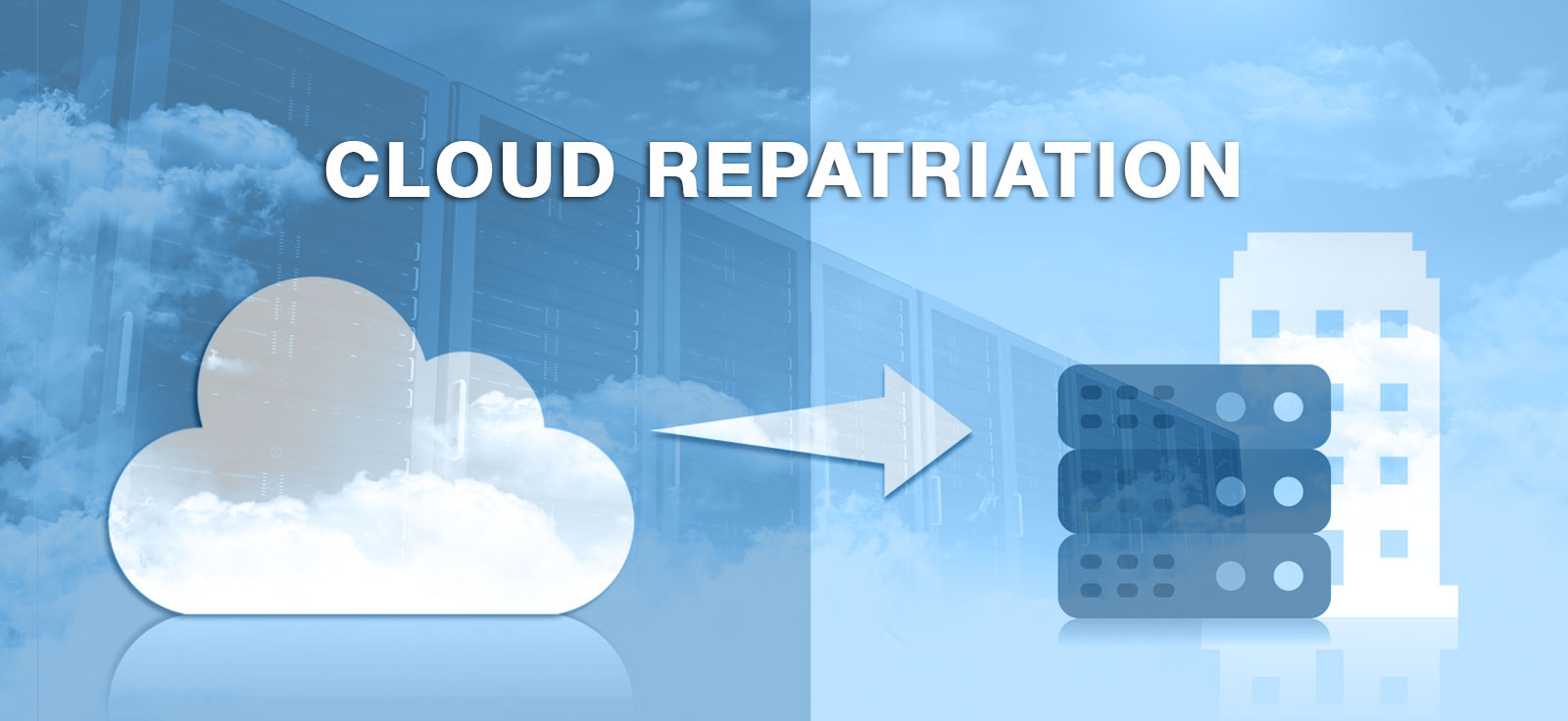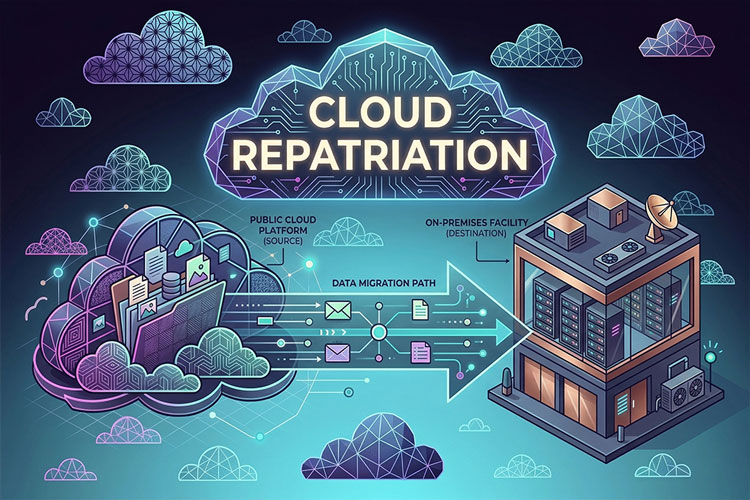
After a decade of cloud-first momentum, enterprises today are taking a closer look at where workloads actually belong, as cost pressures, performance requirements, and regulatory constraints are becoming difficult to ignore. Enterprise cloud adoption is entering a new phase, reflecting broader maturation in cloud strategy and bringing renewed focus to the discussions around cloud repatriation.
No single statistic tells the whole story, but recent surveys paint a compelling picture. A 2025 Flexera report confirms that roughly one-fifth of workloads originally moved to public cloud have already been pulled back into private or on-prem environments, even as net new cloud migration continues. Other industry data suggests that more than 69% of IT leaders are actively considering moving selected workloads out of public cloud, with more than one-third reporting they’ve already done so. Some surveys even show 80–86% of CIOs are planning selective workload moves away from hyperscalers in the near future, pointing to the fact that (at least) selective relocation is dominating current thinking.
As a result, many organizations are choosing hybrid or multicloud architectures to balance flexibility with cost control, compliance, and performance. As enterprises continue to refine their infrastructure strategies, cloud repatriation appears as a symptom, a response to lessons learned during the first wave of cloud adoption, and a foundation for more intentional decisions in the times ahead.
This blog dives into the latest cloud repatriation trends, the reasons companies are choosing to bring workloads back from the cloud, as well as the alternative infrastructure solutions that can deliver the same benefits.
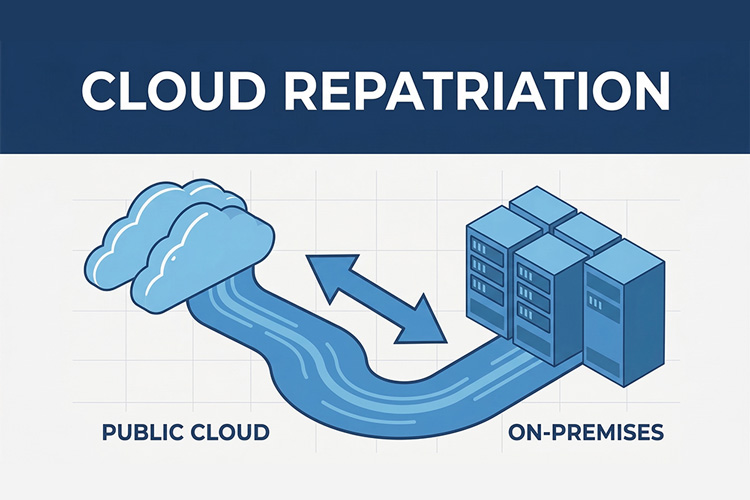
Understanding Cloud Repatriation – What’s Really Happening
The language used to describe cloud strategy is often insufficient to accurately define how enterprises actually run infrastructure today. Yes, cloud repatriation does sometimes imply a decisive and all-encompassing pullback from public cloud platforms; however, most organizations are in the process of discovering that workload placement is, in most cases, far from fixed and permanent.
Cloud providers themselves now deliver services designed to operate inside customer data centers, knowing that some applications benefit from local execution, while still requiring cloud connectivity.
The bigger change, however, is happening in the way infrastructure decisions are framed. Early cloud strategies rewarded speed and commitment, but today’s strategies reward what’s needed today: optionality and the ability to reverse course without disruptions. Enterprises are more inclined to build environments where movement is even anticipated, and, as a result, architectural flexibility is treated as a core, long-term capability.
Cost Optimization and Strategic Realignment
Financial pressure has intensified the conversation around cloud repatriation, but cost is not the only explanation for what is happening.
Cloud spending is now visible at the board level. Unpredictable bills and long-term exposure draw far more scrutiny than they did just a few years ago. Enterprises now recognize that pay-as-you-go pricing is not always beneficial to steady-state workloads, which leads to renewed efforts to reduce cloud costs by reassessing where applications run. This analysis has led many organizations to bring workloads back on-premises, where utilization patterns are more transparent and economic modeling is simpler.
Of course, recent data growth intensifies these dynamics. Traffic patterns that were marginal with lower data volumes can generate significant charges, often retroactively. Consequently, storage decisions made incrementally without a long-term view can also distort expected outcomes over time. Private cloud infrastructure is regaining appeal against this backdrop as a means to achieve more predictable budgeting and a clearer total cost of ownership for specific workloads. According to recent industry surveys, around 80% of enterprises expect to repatriate some compute or storage workloads from the public cloud in the year ahead. A Barclays CIO study found that 83% of enterprise IT leaders plan to shift at least some workloads off public cloud to on-premises or private infrastructure.
If we look at it from this angle, cloud repatriation is not just a retreat in panic from the public cloud, but the result of a more mature, informed, and financially disciplined strategy, where the goal is finding the ideal match between workload characteristics and infrastructure models.
Mobility, Compliance, New Operational Realities
Operational realities are also reshaping how organizations think about workload movement today. Applications are no longer expected to remain fixed after deployment. Shifts in security posture, regulatory interpretation, or application maturity repeatedly call for reconsideration of where software should run.
Regulatory pressure is definitely speeding things up as well. Frameworks like DORA are already enforceable in the EU, and regulators in the UK and the U.S. increasingly expect more evidence of control besides contractual assurances. Organizations have to demonstrate how data is protected, who controls encryption keys, and how exit scenarios are handled. The increasing strictness of compliance requirements has pushed many organizations towards cloud repatriation: the trend is now gaining traction because businesses want verifiable control.
However, most organizations don’t want to abandon cloud capabilities altogether, and for them, hybrid architectures are the next logical step. Designs that assume and plan with the change factor built in allow enterprises to adapt without rewriting their strategy every time conditions change. Within this model, cloud repatriation functions as an operational lever: supporting intentional workload placement in an environment where flexibility is highly valued.
Hidden Expenses
Infrastructure costs are often evaluated through cloud invoices, but a growing share of expenses sits outside the line items that appear on the monthly bill – this is a reality that increasingly appears in cloud repatriation discussions. As cloud environments mature, organizations incur additional overhead in the form of specialized expertise, tooling to manage multiple platforms, and the continuous effort needed to track and optimize consumption. These costs gradually add up and often surface only after architectures reach higher levels of operational complexity.
Multi-cloud strategies amplify this and often prompt earlier cloud repatriation planning. With multi-cloud, each platform introduces its own operating model, pricing logic, and security controls, which require highly specialized cloud engineering skills. Over time, staffing and coordination costs can rival or exceed infrastructure savings. In contrast, many enterprises arrive at the conclusion that existing infrastructure teams supporting on-premises environments deliver stronger continuity and cost predictability, particularly for stable workloads targeted for cloud repatriation.
This dynamic is driving a more sober assessment of operational efficiency. For certain use cases, simplifying architectural design can deliver tangible economic benefits, reinforcing cloud repatriation as a solution to sustaining control and long-term manageability.

Performance and Latency as Strategic Constraints
Performance and latency expectations are critical factors contributing to recent cloud repatriation trends.
Matching Platforms to Application Behavior
Performance has always been important, but recently, it has reasserted itself as one of the most central concerns in infrastructure planning, particularly as enterprises revisit decisions made during the first wave of cloud adoption and reassess cloud repatriation options.
Many CIOs who moved aggressively to the cloud in the beginning are now recalibrating. Attention is moving toward aligning applications with platforms that support specific operational needs within a broader hybrid cloud strategy. This can involve private cloud infrastructure, industry-focused cloud services, on-premises or colocation facilities, edge deployments, or tightly coordinated multicloud architectures – depending on the workload.
The noticeable tendency towards recalibration reflects a growing understanding that some applications are struggling under layered abstraction. Workloads that require predictable response times, minimal jitter, or direct access to specialized hardware can encounter limitations in shared or virtualized environments. High-frequency trading systems, real-time gaming platforms, and AI or machine-learning pipelines are frequently cited examples, where even the slightest increases in latency can materially affect outcomes. All these make it clear why cloud repatriation decisions have been accelerating lately.
Data Gravity and the Limits of Distance
As data volumes continue to grow with AI adoption, physical constraints are playing a larger role in architectural decisions related to cloud repatriation. Datasets measured in terabytes now routinely reach the petabyte scale, and data movement between environments is becoming increasingly complex. Transfers across cloud regions or back to centralized systems can experience delays and operational friction, as well as cost exposure that many organizations did not fully anticipate during their early cloud planning.
These realities are initiating transformations and a more grounded approach to infrastructure design. Performance is no longer assessed solely through benchmarks or provisioning speed; evaluation increasingly centers on how applications behave over time and where data naturally resides. As enterprises absorb these lessons, infrastructure decisions favor proximity and control more and more. In this landscape, cloud repatriation is a practical, down-to-earth response.
Hybrid Strategies as an Operating Model
For a long time, hybrid infrastructure was treated as a temporary phase, something companies used while they were figuring out their move to the public cloud. But that has changed, and today, hybrid has become a stable operating model for enterprise IT. What’s important in this context is that for many companies, cloud repatriation happens because of leaning more and more towards a hybrid operating model. At the same time, when you design your environment to span across on-premise, colocation, and cloud from the beginning, bringing workloads back doesn’t become disruptive.
Because different workloads have different requirements, performance, regulatory constraints, cost pressures, and operational capabilities that all vary, sometimes significantly. Hybrid architectures give organizations room to respond to those differences. They let teams move workloads into the cloud when it makes sense, and move them back on-premises when conditions change, without having to rethink the entire infrastructure strategy each time.
Best-of-Both-Worlds by Design
Modern hybrid strategies focus on combining complementary strengths across different environments. Public cloud platforms deliver elasticity and rapid provisioning, and on-premises and private environments provide control, predictability, and proximity to data. Hybrid architecture allows organizations to align each workload with the environment that best supports its requirements, while maintaining data sovereignty and compliance objectives central to many cloud repatriation initiatives.
Preserving choice is another important value of hybrid strategies. Placement decisions can evolve as conditions change, making adaptability a core capability – this is what’s often behind many cloud repatriations.
Optimization as a Continuous Discipline
Hybrid infrastructure delivers value through ongoing optimization, especially in the case of organizations seeking to reduce cloud costs through selective cloud repatriation. Workloads evolve, and the conditions surrounding them evolve as well. Cost pressures fluctuate, compliance requirements change, and application behavior matures over time.
Clear placement criteria provide a starting point. Some applications benefit from elasticity and broad reach, but others perform best in controlled environments with predictable resource usage. As business priorities change, those criteria are refined, and this is when cloud repatriation should be an option that can be executed easily and deliberately.
Containers and Kubernetes as Enablers
Application portability has long challenged hybrid environments and complicated cloud repatriation planning. Differences in tooling, configuration, and operational models historically made movement between platforms difficult. However, containerization has reduced these barriers by packaging applications and dependencies into a consistent runtime. Kubernetes plays a crucial role by providing a shared orchestration layer across on-premises, private cloud, and public cloud infrastructure. This consistency simplifies deployment, scaling, and lifecycle management, making cloud repatriation technically viable without extensive reengineering.
Connectivity as the Hidden Requirement
Hybrid strategies that support cloud repatriation stand or fall on connectivity. Compute and storage decisions tend to dominate architectural discussions, but in practice, it is the network that determines whether hybrid environments behave as a cohesive system or as a collection of loosely connected islands. Secure, high-performance connectivity underpins workload mobility, data synchronization, and centralized control. When network design is only an afterthought, hybrid architectures can lose their operational integrity.
Inside the data center, connectivity becomes even more consequential. As application architectures are growing more distributed, east-west traffic between compute, storage, and platform services continues to increase. Latency, congestion, or inconsistent throughput within the data center can quickly negate the benefits of moving workloads locally. For organizations planning cloud repatriation, this internal network fabric has to support higher volumes of inter-service communication and predictable access to data.
The ability to provision fast, deterministic connections on demand is no longer a convenience but an architectural requirement. Network capacity has to scale in step with compute and storage, without introducing manual complexity or operational risk. This applies equally to connectivity between private and public environments and to the internal paths that tie application tiers together within the data center.

Building for Movement
Planning hybrid strategies successfully today starts with a simple acknowledgment: workload placement will change. Decisions made today are a consequence of current costs, regulations, and performance needs, but those conditions won’t stay fixed. When planning assumes movement from the start, cloud repatriation becomes a manageable option and avoids unnecessary disruption.
Connecting infrastructure to long-term goals ensures cloud repatriation supports innovation, operational efficiency, and competitive positioning. Seen this way, cloud repatriation becomes part of long-term architectural thinking, creating infrastructure that adapts as business needs evolve.
Plan Forward With Volico
When enterprises plan cloud repatriation, Volico Data Centers delivers a comprehensive connectivity platform that helps organizations maintain performance, control, and adaptability across their IT environments. Built atop carrier-neutral colocation facilities with redundant network infrastructure and high-performance fiber, Volico’s suite of services supports the movement of workloads, the deployment of hybrid models, and integration with edge and cloud ecosystems at scale.
Network & Interconnection: Volico’s connectivity solutions provide enterprises with secure, low-latency access to major telecommunications carriers, internet service providers, and cloud providers directly through flexible interconnection options. Dedicated Internet Access (DIA), blended IP, dark fiber, and wavelength services allow businesses to tailor connectivity to their performance and reliability requirements. These options support hybrid efficiency and make it easier to connect local infrastructure with remote environments, a key consideration when planning cloud repatriation.
Cross-Connect Services: Strategic cross-connects at Volico facilities enable private, high-performance links among partners, carriers, and ecosystems. These physical cabling options reduce latency and improve throughput, strengthening the backbone needed for hybrid operations and enhancing performance for workloads that transition between environments.
Carrier-Neutral Advantage: As a carrier-neutral provider, Volico allows customers to choose from a broad range of connectivity partners at each location. This flexibility reduces dependency on a single network provider and supports business decisions to bring workloads back on-premises or extend into on-premises or colocation facilities as requirements evolve, without sacrificing connectivity quality or control.
Together with Volico’s secure colocation footprint and managed support, these connectivity capabilities form a reliable foundation for enterprises seeking to align performance, compliance, and operational efficiency with broader IT strategies — including cloud repatriation and hybrid growth paths.
Contact us today to learn more.