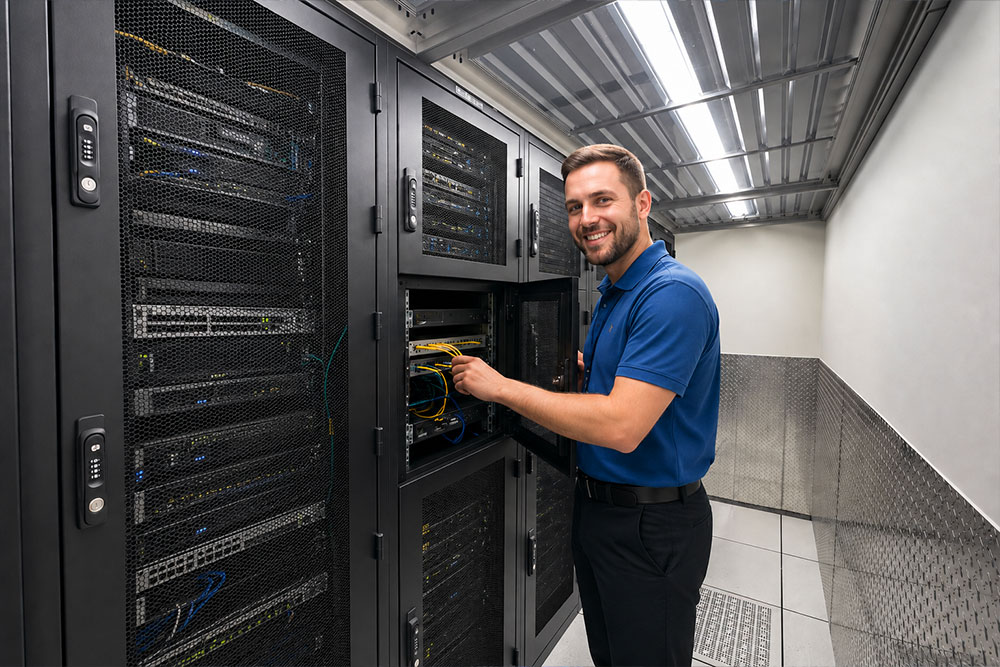
Are you choosing a suitable data center for your business? The tier concept matters because it affects performance. It can also decide how efficiently a business runs and how reliably it delivers its goods and services. In essence, data center tiers rank the reliability levels a facility can guarantee.
A data center tier, or level, sets key requirements such as redundant components, cooling, and load distribution paths. Each tier has a precise definition. The simplest way to compare data center tiers is reliability, measured by how long a facility stays offline each year on average.
So what sets data center tiers apart, and how does a facility move up a tier? How many tiers are there, and how are they defined? Here, we cover the four established tiers and the fifth, which emerged only recently. The fifth tier adds stricter requirements and better reliability and redundancy. Let’s go through each one to build a basic understanding.
Tier 1 Data Center (Basic capacity)
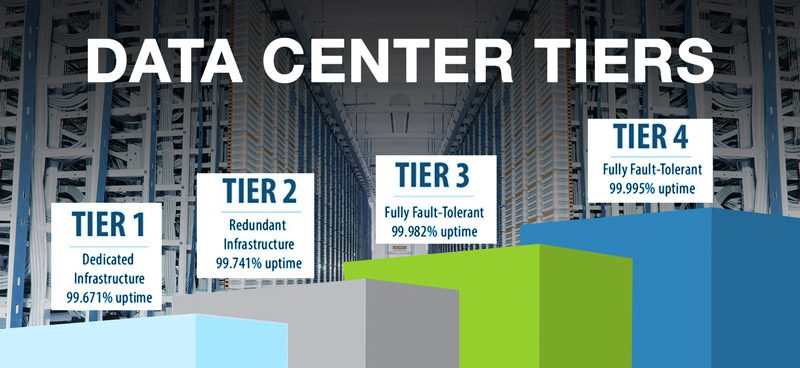
A Tier 1 data center is the simplest and lowest level. Its uptime is around 99.671%, which is lower than other tiers because it has little or no redundancy. As a result, power and cooling equipment has only a single path, so downtime reaches 28 to 29 hours every year.
Small businesses with no complex requirements can choose Tier 1 and be well served. Most of them need data centers for record keeping and corporate correspondence, so complete and unfailing reliability is not always a top priority. The stakes are relatively low, so the cost savings of a Tier 1 facility outweigh the advantages of a higher tier.
Tier 1 facilities have limits, though. Because they lack intrinsic reliability, they cannot serve businesses that cannot tolerate hampered service. They also lack extensive redundancy and other key design features, so companies that need failproof service should look higher.
Tier 2 Data Center (Redundant capacity components)
A Tier 2 data center has an uptime of 99.741%, which means no more than 22 hours of downtime a year. Like Tier 1, it still has a single path for power and cooling. However, it adds some redundant components, such as a backup generator or cooling equipment, which raises its reliability. Tier 2 may not look very different from Tier 1, but it is markedly more reliable.
Many mid-sized businesses rely on this extra reliability. They need more than Tier 1 provides but cannot afford a higher tier. Tier 2 has a limit, though. It cannot operate during maintenance, so clients with more demanding requirements look elsewhere.
Tier 2 also stands out for performance relative to its operating costs. Unlike Tier 1, it uses redundant hardware and software that substantially improve up and down speeds. Operating costs stay reasonable.
Tier 3 Data Center (Comprehensive redundancy)
A Tier 3 data center suits larger companies. Its uptime is around 99.982%, so it won’t go down for more than 1.6 hours in a year. Uptime improves considerably over Tier 2. Tier 3 has sophisticated infrastructure, a high redundancy level, and multiple paths for power and cooling. Every component also connects to multiple power sources. If one source fails, another takes over, so performance isn’t affected.
Teams can do maintenance and repairs without shutting off the system. Built-in measures also protect the entire data center from a power outage. Compared with Tier 1 and Tier 2, Tier 3 offers far superior reliability. Naturally, that makes it a clear choice for businesses and institutions that prioritize reliability.
Law enforcement departments, fire departments, and healthcare facilities often choose Tier 3 for its superior reliability and security. So do companies that want a reputation for dependable service. Many buyers also pick Tier 3 as a compromise between performance and affordability, because it outperforms Tier 2.
Tier 4 Data Center (Fault-tolerant)
Mega enterprises often select a Tier 4 data center, which exceeds the performance of all three tiers above. Its uptime reaches 99.995%, so downtime totals only 0.5 hours in a year. A Tier 4 facility also provides 96-hour protection from a power outage. Multiple redundancies keep performance consistent despite extensive equipment failure.
Tier 4 redundancy is prohibitively expensive to operate and maintain. Even so, companies with the resources to use the improved performance and reliability do so without hesitation. Government agencies also often run their own data centers that meet Tier 4 requirements.
Tier 5 Data Center
A Tier 5 data center is a relatively new trend. It meets all Tier 4 requirements and adds more, including operation without water, air pollutant detectors, securable server racks, and energy system monitors. Local and renewable power projects usually prefer Tier 5.
Tier 5 offers a unique set of benefits compared with the lower tiers, which creates a niche in the market. Whereas the lower tiers differ by their rising reliability and performance, Tier 5 has a more complex and nuanced appeal. To put it simply, it adds benefits on top of its exceptional performance and reliability.
This tier appeals primarily to organizations that care about public perception of their environmental policy. Tier 5 supports an “eco-friendly” public image. It offers a level of perceived environmental concern that discussions of the lower tiers often overlook. In short, Tier 5 data centers are worth the exorbitant amounts they cost to build and operate.
When choosing a data center, start with your need for data availability. Then ask how much downtime your business can tolerate without significant impact on its operations. For businesses with high availability and increased security needs, a Tier IV data center is the recommended option.
Discover how Volico can help you with your Data Center Colocation needs.
• Call: (305) 735-8098
• Chat with a member of our team to discuss which solution best fits your needs.