Businesses of all types need their computers running at all times. That includes healthcare, financial, retail, communications, and service companies. Downtime means lost customers, a damaged reputation, and other financial losses. Company computers need high availability, which means they should virtually never fail.
More and more businesses and organizations rely on high-availability data centers to keep their systems and data operating.
Why Is Data Center Redundancy Necessary?
Unfortunately, many parts of a company’s information system can fail. Attacks, poor programming, natural disasters, and other problems can all cause damage. Any availability strategy must include a way to troubleshoot emergencies quickly.
Information systems need to be redundant. That means the data center should replace a failed system with a working one immediately. Redundancy keeps the company running while the data center finds why the system failed, so the problem does not recur.
How Much Data Center Redundancy Does Your Business Need?
Company IT personnel need to work with the data center to choose the right level of redundancy. Backing up an entire system can be costly. However, backing up only part of it may leave the company unable to provide essential services. So a company must know the exact level of redundancy it needs to resume operations.
To make this determination, companies should consider the following:
- How far back must you restore systems: a week, a day, or an hour before the emergency?
- How long can the system be down before actual economic losses begin?
- Which programs depend on other programs?
The answers help determine the level of redundancy the company needs to stay operable. That level directly affects the cost of operation, and therefore the price of the service. Clients that need unfailing reliability because of their business model need higher levels of redundancy. Clients that do not can choose lower levels.
Of course, lower levels of redundancy mean more potential downtime over the long term. That downtime can last for hours or days with no access to corporate data. More redundancy means less downtime but higher costs. However, if your business needs minimal downtime, the cost often pays for itself in profit and growth.
Different Levels of Redundancy: 2N and 2N+1 vs. N+1 and N+2
N ratings measure server redundancy. N is the infrastructure a data center needs to run at full capacity under a specific workload. In practice, this usually means cooling capacity and uninterruptible power supplies, though it can apply to other systems too.
Naturally, N is a baseline measure of functionality without redundancy. Few data centers operate at this level because the excess downtime would quickly send clients elsewhere. Thus, the industry standard for minimum redundancy is N+1. With N+1, every four components in use share one backup, which covers failure or maintenance.
N+2 and 2N: Stronger Protection
N+2 takes this principle a step further, with two redundant units for every four units in use. This improves reliability substantially, so the facility can handle more maintenance or failure at full workload. N+2 is often enough to keep clients with moderate reliability needs.
A 2N rating means every component in use has a duplicate unit ready for maintenance or failure. It is the minimum level for companies and institutions that need near-complete reliability. Hospitals, police departments, and research and development labs are examples.
2N+1 is the last commonly used level of redundancy. It gives each unit in use a redundant component, plus one additional unit for every four components. Data centers with 2N+1 redundancy can reliably guarantee downtime of no more than 26 minutes per year. Higher levels exist, but almost no clients use them unless they have ultra-demanding reliability requirements.
How Does Data Center Redundancy Work?
Each level of redundancy offers a different amount of protection. N+1 is generally the weakest, 2N is stronger, and 2N+1 is stronger still. The best way to understand these terms is with an example. As we discussed earlier, these are the standard levels of redundancy. But how do they work in practice? Next, we’ll explain N+1, N+2, 2N, and 2N+1 in simple terms.
Suppose you are holding an event where N people need seats. Minimal planning dictates N+1 chairs. The extra chair is there in case one breaks. N+2 is somewhat better, because you can replace two chairs. A better strategy is 2N chairs, two for each person. With 2N chairs, you don’t have to worry about how many chairs break or malfunction. You will always be ready to reset the whole table with a full set of chairs for everyone.
2N chairs have a second advantage. Even if a few break, you can send everyone to another table with the second set of N chairs. While guests use the second table, you can inspect the first set for chairs that broke or might break.
2N+1 just means you have twice as many chairs as you need plus an extra one to boot.
Applying the Analogy to Your Data Center
Now compare this to computer systems. N+1 means you have enough components for an emergency, plus one extra. The problem is that you can still use only one circuit, one generator, or one feed.
With 2N components, the data center can use a second circuit, generator, or feed to restart operations. It does not matter whether the original damage was partial or full. 2N+1 redundancy adds one more component to the double feed for extra protection.
Of course, these systems are not fail-proof. A duplicate server can always fail. A disaster can also be so severe that no level of redundancy restores operations promptly. This is why redundancy is just one piece of a comprehensive disaster recovery plan.
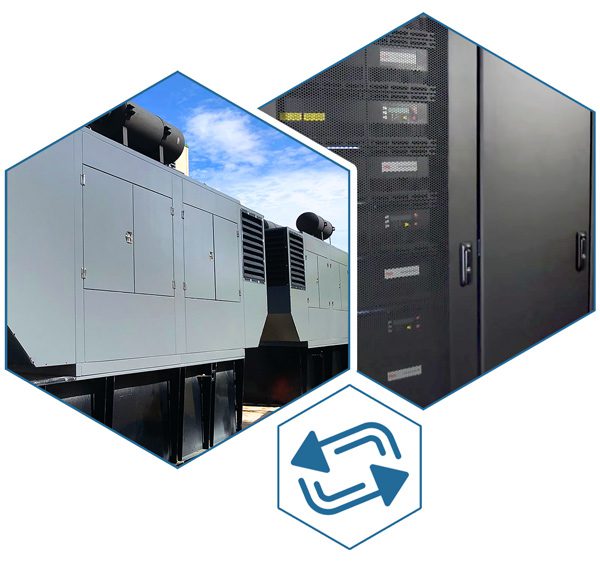 Make your systems highly available by maximizing the redundancy to replace or fix them
Today, the demand for information is constant. Companies that are offline for any length of time risk losing business to competitors. Data centers help companies give staff and customers access when they need it. The best data centers keep your company online by maximizing redundancy when an emergency occurs. Call Volico at (305) 735-8098 to learn how a data center can be your best disaster protection resource. Our professionals are ready to talk today.
Ready to See How Volico Data Center Can Help You?
Got questions? Want to talk specifics? That’s what we’re here for.
Have one of our friendly experts contact you to begin the conversation. Discover how Volico can help you with your Data Centers’ needs.
• Call: (305) 735-8098
• Chat with a member of our team to discuss which solution best fits your needs.