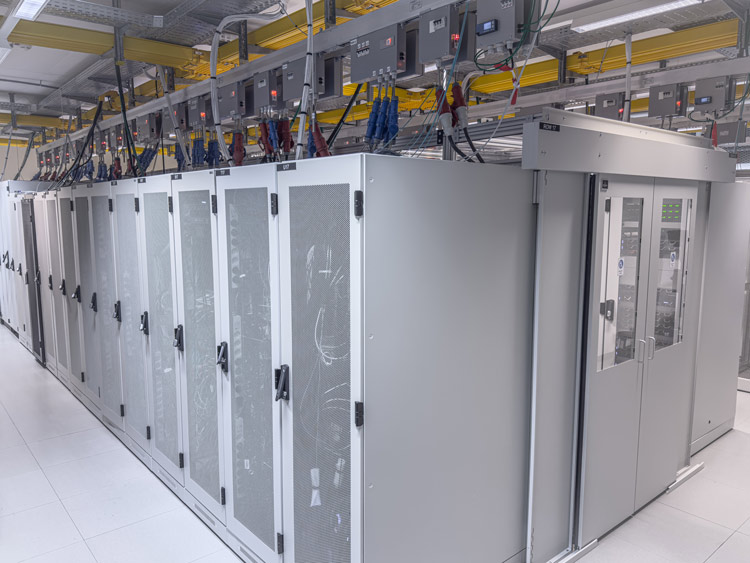
Many people call data centers the backbone of our digitalized world. They truly are crucial for the uptime of countless businesses and applications. Demand for bandwidth keeps growing as new technologies pick up speed. Because of that, data centers rely heavily on their network infrastructure to stay available in a constantly changing environment. Even small periods of downtime can cause significant revenue loss for organizations, leading to reputational damage and a lengthy recovery. Under these circumstances, excellent data center uptime is no longer a negotiable extra but a marker of performance and reliability. Unsurprisingly, most organizations require a 99.99% data center uptime for their most important applications and hardware.
Network infrastructure plays a key role in securing data center uptime. The Uptime Institute’s Annual Outage Analysis for 2023 found that network connectivity issues caused 31% of outages over three years. That is more than power-related issues caused.
Data center uptime plays a crucial role in keeping organizations running. Operators therefore focus on improving redundancy, compliance certifications, and overall efficiency.
This blog explores the challenges of delivering data center uptime. It also covers what operators need to watch to reach their performance goals. Let’s jump in.
The Challenges of Delivering Data Center Uptime
Because data centers, technology, and business depend on each other, priorities keep shifting. They always bend to the demands of the moment. It’s no secret that meeting clients’ high expectations takes extensive effort from the data center. New technologies require constant changes and adaptations, so the effort only grows. Operators face wave after wave of new complexity. They have to invest considerably in their network infrastructure to accommodate new requirements and ensure the best uptimes.
Common Causes of Data Center Downtime
System failures are among the most common causes of data center downtime. They are frequent with old, unstable equipment and a lack of proper monitoring. Even new servers, networking equipment, and storage devices can fail. Unexpected changes in temperature or humidity are one example. Although identifying the factors behind these failures can be challenging, regular maintenance and efficient monitoring can minimize glitches and crashes. They also reduce unplanned downtime and secure availability.
Natural disasters and UPS failures cause power outages, and those outages have long topped the list of downtime causes. However, there are other, more sneaky threats to data center uptime, like human error. Human error can cause issues at any level, be it hardware, network, or management-related. Misconfiguration and accidental deletion are some of the most frequent causes of incidents. These errors are slippery because operators can only partially plan or prevent them.
Successful cyberattacks are another great enemy of data center uptime. DDoS attacks, ransomware, and all kinds of malicious actions constantly hit data centers. These attacks can lead to compromised systems, data theft, and system failures.
Increasing Numbers of Network Infrastructure – Related Data Center Challenges
The Uptime Institute’s 2023 report (linked in the introduction) shows that network infrastructure issues are becoming more common. Configuration and change management failure is the top cause of network downtime at 45%. Third-party network provider failure follows at 39%. The complete list of the main causes of network-related outages provided by Uptime Institute’s report is as follows:
Configuration/change management failure 45%
Third-party network provider failure 39%
Hardware failure: 37%
Line breakage 27%
Firmware and software error 23%
Cyberattack 14%
Network/ congestion failure 12%
Weather-related incidents: 7%
Corrupted firewall/routing tables issues: 6%

What’s Behind the Recurrence of Network-Related Issues
Networking used to be a lot more straightforward and predictable, because cabling, routers, and switches didn’t need much management. However, today’s software-defined, dynamically switched environments require a completely different approach. Constant reconfiguration inevitably creates more opportunities for errors, and those errors can eventually cause a failure. Errors can be hard to diagnose in time. In many cases, the domino effect has already started by the time anyone discovers the error. That makes it even harder to stop.
Nevertheless, there’s a legitimate explanation for recurring network-related data center uptime issues. It has to do with recent large-scale digital infrastructure shifts. Transitioning to hybrid architectures brings a lot of complexity. It requires a dynamic approach and constant vigilance to avoid errors.
Design Issues
Network infrastructure-related issues can go back all the way to the design. Different networking technologies have different needs, so network engineers must figure out the best arrangement to maximize performance. Today’s many software-defined networking options also make errors more frequent, since each one operates differently and has different requirements. It is a real challenge for network operators to handle all this complexity with confidence.
Network design tools make it possible to model the network before building it. Engineers and technicians get a preview of what the configuration will look like. This allows a strategic approach that makes it easier to rule out errors and spot anomalies.
Multi-Vendor Environments and Configuration Issues
Networks are inherently complex, but the complexity becomes truly highlighted in the case of multicarrier colocation data centers. Several telecommunications providers serve them. That can cause issues because their connections often rely on the same cables and infrastructure. If something goes wrong with a link, it can mess up things for everyone involved.
Third-party networking issues are a frequent cause of outages. Since so many things are intertwined, they are very difficult to control. However, focusing on network redundancy and resiliency can contribute to averting these issues and securing data center uptime.
Also, relying solely on one company for network equipment and services is expensive and hardly efficient. A multi-vendor approach makes it easier to set up networks correctly. It also minimizes misconfigurations and the weaknesses they cause, such as higher exposure to DDoS or ransomware attacks. Scaling and maintenance also become more efficient.
Cables as a Source of Failure
Optical transceiver and AOC cable manufacturers often soften component specifications to push costs lower. That threatens data center uptime. If testing misses the problems, this becomes a prime point of failure. Network testers can identify these issues by checking things like interface connections, timing differences, power levels and usage, and temperature.
Data centers often use intricate, high-fiber cable designs to connect multiple patching racks and data halls. Those halls can be spread across several separate locations. In this setup, cables that follow structured cabling standards often end in multi-fiber connectors. Parallel fibers in those connectors handle high data rates. This setup, however, is prone to fiber polarity challenges and constraints on loss and length. These limits come from the modulation methods and high data rates. In these complex setups, technicians can use optical fiber multimeters and optical time domain reflectometers. These tools find compromised connections, bends, and breaks.
Data Center Interconnection Issues
Increasingly complex data center interconnections can lead to downtime because managing and troubleshooting them is so intricate. As data centers scale, they rely on diverse technologies like coherent optics and dense wavelength-division multiplexing (DWDM). As a result, the risk of misconfigurations, compatibility issues, and equipment failure increases. Troubleshooting complex setups often requires specialized knowledge and tools like different kinds of testers. This is especially true when optical fiber paths are suspect. The specialized expertise and tools are not always readily available, making them difficult to tackle.
A Prognosis is Better Than a Diagnosis
Rigorous design and testing are no longer just options. They are vital for preventing network-related outages and ensuring excellent data center uptime. The world and our lives are becoming more data-driven. As a result, data center reliability will foreseeably stay the number one priority. Downtime is not an option anymore, and expectations for performance are high. Operators and network engineers have to take extensive measures to deliver 100% uptime and performance. Those measures center on redundancy and preventive maintenance.
To learn more and avoid downtime for your business, check out our solutions at Volico Data Centers. We offer top-tier, carrier-neutral solutions with excellent connectivity and the security of a redundant network infrastructure.
For more information, call (305) 735-8098 or chat with one of our specialists to learn the details.