Regional, national, and worldwide businesses must weigh many issues in their information technology. IT departments want expansion, performance, high bandwidth, and low latency, but they also need security, privacy, and regulatory compliance.
Companies can expand by connecting multiple data centers. Dark fiber networks and advanced WDM technology supply the broader bandwidth capacity that makes this possible.
Dark Fiber
Dark fiber networks are optical fiber networks that businesses use privately, for private networking or for Internet networks. A different supplier owns the fiber itself. Telecommunication companies often hold that ownership because they physically laid, built, and connected the cable networks. A business leases dark fiber from a telecommunications owner or network service provider instead of a traditional carrier. Some businesses now buy these dark fiber networks instead of leasing them.
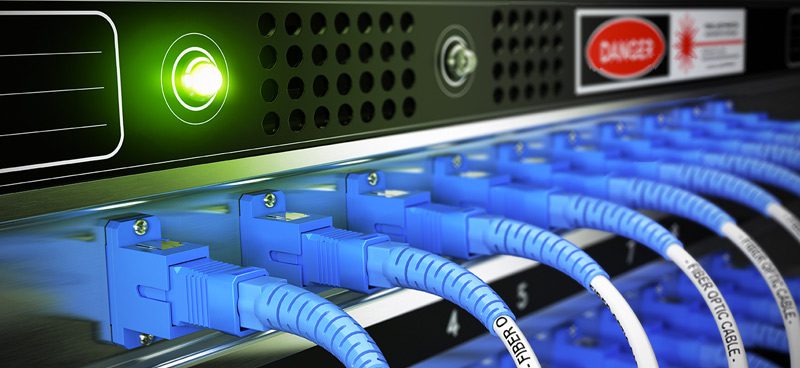
Businesses favor fiber optic cabling for its high bandwidth, reliability, and low latency (wait time). It also delivers strong security and minimal data loss. Dark fiber can be expensive, though, because of high leasing or purchase costs. To make that cost worthwhile, companies add WDM technology. WDM (Wavelength Division Multiplexing) helps businesses achieve high connectivity. It also addresses security concerns, such as encrypting data that passes over the fiber.
Recently, higher education institutions have purchased large amounts of dark fiber to expand their connection capabilities. These connections link schools to hospitals, telecommunication companies, and research companies. Telecommunications companies laid too much cable, so dark fiber is available at a low cost. It has been a boon to many organizations and schools. Dark fiber can also help most businesses expand their networks, whether they connect privately or through data centers.
WDM, CWDM, and DWDM
WDM technology uses several different wavelengths of light, so each wavelength (or frequency) can carry a different kind of data. In fiber-optic communications, WDM multiplexes different carrier signals, or data streams, onto a single optical fiber.
WDM comes in two wavelength patterns: CWDM (Coarse WDM) and DWDM (Dense WDM). CWDM allows up to 16 channels, so it expands the utility of the optical fiber up to 16 times. DWDM uses denser channel spacing to raise the scalability factor to as many as 96.
CWDM typically costs less than DWDM because its scalability factor is lower and it needs fewer controls. DWDM technology needs to be more stable than CWDM technology, so it requires precision control of the transmitter’s temperature. On the other hand, DWDM uses higher modulation rates, which can be less desirable than the lower CWDM modulation rates. CWDM is now a popular choice for cable television networks.
Call Volico today for help expanding your network
Whether you buy dark fiber, lease it, or add WDM technology, you have new ways to grow your network. Those options can connect your company across the country and around the world. Call Volico at (305) 735-8098 to learn how optical fiber and developing technologies can help your business grow. You can speak with one of our representatives.
Ready to See How Volico Data Center Can Help You?
Got questions? Want to talk specifics? That’s what we’re here for.
Have one of our friendly experts contact you to begin the conversation. Discover how Volico can help you with your Data Centers Connectivity needs.
• Call: (305) 735-8098
• Chat with a member of our team to discuss which solution best fits your needs.