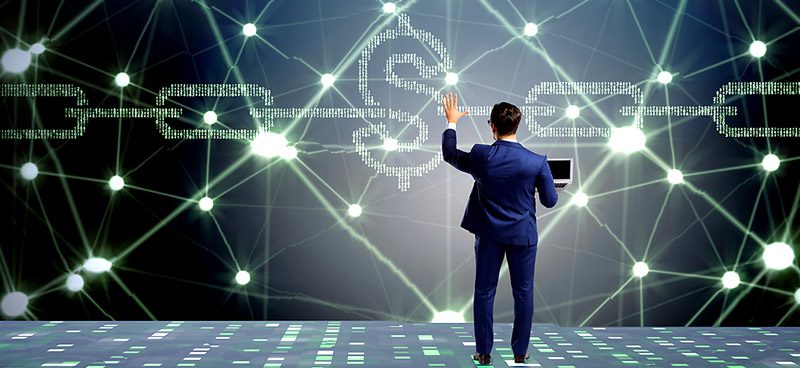
Blockchain, also called distributed ledger technology, is a new form of technology that businesses can implement in numerous ways. Companies use it because it offers stronger security. Blockchain allows a computer network to regularly (at specific intervals) agree on the true condition of a distributed ledger. Ledgers contain different kinds of data including transaction records. Unlike traditional networks, which use nodes, blockchain secures its ledgers with encryption (Crypto Tokens) and game theory. Bitcoin, a global encrypted payment system, is a major user of blockchain technology. That is why Bitcoin can complete transactions worldwide without going through banks as intermediaries.
According to MIT Sloan Assistant Professor Christian Catalini, an expert in blockchain technologies and cryptocurrency:
“On a blockchain, transactions are recorded chronologically, forming an immutable chain, and can be more or less private or anonymous depending on how the technology is implemented. The ledger is distributed across many participants in the network — it doesn’t exist in one place. Instead, copies exist and are simultaneously updated with every fully participating node in the ecosystem. A block could represent transactions and data of many types — currency, digital rights, intellectual property, identity, or property titles, to name a few.
“The technology is particularly useful when you combine a distributed ledger together with a Crypto Token,” Catalini says. “Suddenly you can bootstrap an entire network that can achieve internet-level consensus about the state and authenticity of a block’s contents in a decentralized way. Every node that participates in the network can verify the true state of the ledger and transact on it at a very low cost. This is one step away from a distributed marketplace, and will enable new types of digital platforms.”
The benefits of using blockchain technology
There are many financial, practical, and technical advantages to using blockchain technology. The benefits include reducing the cost of verifying transactions. Businesses sometimes need to verify the identity and credentials of clients, vendors, partners, and other business parties. Distributed ledger technology makes verification virtually free because it already recorded the credentials, and anyone can double-check them easily. For example, Bitcoin is accurately able to verify the funds in the account match the request for withdrawal. Blockchain reduces or eliminates the need for banks or an entity like PayPal.
According to Catalini, blockchain technology will also cut the expense of “running a secure network.” Using intermediaries requires an extra level of security to verify the intermediaries. Eliminating the intermediaries eliminates a level of security.
Another benefit is better privacy. With blockchain technology, business transactions share only the information the other business needs to know. They withhold anything extra, so bad actors never get a chance to misuse it. This keeps data more private. It will be easier to track goods and manage global transactions with blockchain technology.
Which businesses will be affected by blockchain technology.
The benefits of blockchain will help some businesses and hurt others. For example, banks and intermediary companies like PayPal will not be needed as much, though both entities, recognizing the advantages of the blockchain, are developing and buying blockchain alternative companies.
Some of the business sectors that can benefit (in years or decades) are:
- Central banks, because it will be cheaper and more secure to handle many different types of payments.
- Financial companies that can better verify payments such as international payments.
- Companies that transfer money.
- Companies that offer services a la carte. For example, some sites charge you per article instead of charging you for a subscription.
Many other opportunities exist in the industrial, commercial, and technical sectors.
Learn more about blockchain technology
Distributed Ledger Technology (blockchain technology) is expanding because it helps validate data, making direct financial transactions more secure. Want to learn more about how this technology works and how it can benefit your company? Ask to speak with one of our data center representatives.