The Inergen Fire Suppression System is a “Green,” environmentally friendly inert gas solution built to meet fire suppression requirements in today’s Data Center Facilities.
In our new VOLICO 2.0 Broward Data Center, we use Ansul’s Inergen Fire Suppression System. This is an engineered fire suppression system utilizing a fixed nozzle gas distribution network. The system also complies with National Fire Protection Association (NFPA) draft standards for Clean Gas Fire Extinguishing Systems.
How the Inergen Fire Suppression System Works
The Inergen Gas, or the “Active” ingredients in the Inergen Fire Suppression System, is a mixture of three inerting or oxygen-diluting gases: 52% Nitrogen, 40% Argon, and 8% Carbon Dioxide. In layman’s terms, Inergen Gas extinguishes fire by lowering the oxygen content below the level that supports combustion. When discharged into a room, Inergen gas reduces the oxygen in the air from 21% down to below 15%. A person can still breathe safely in this reduced oxygen atmosphere.
In fact, releasing this Inergen gas increases the carbon dioxide in the room from less than 1% (a normal level for this gas) to approximately 4%. This increase raises a person’s respiration rate and improves the body’s ability to absorb oxygen into the bloodstream through the lungs. Simply stated, the increase in carbon dioxide naturally stimulates the human body. Similar to asthma inhalers, this biochemical pathway allows for deep and rapid breaths that compensate for the lower oxygen content in the room’s atmosphere.
As the Inergen gas consists of inert gases already present in the Earth’s atmosphere, it is truly a “Green” gas. It does not deplete the ozone layer, nor does it contribute to global warming. Most importantly, it does not pollute our atmosphere with the toxic chemicals found in other suppression systems, such as FM200, FE25 Ecaro, and Halon “agent-based” systems.
Deployment of the Inergen Fire Suppression System in the Data Center
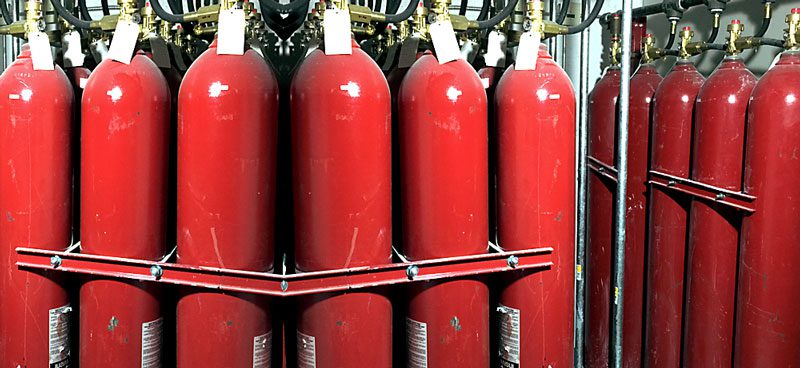
The basic Inergen system stores extinguishing gas in high-strength alloy steel cylinders, located in a safe and accessible location. Various manual or automatic actuators and distribution “vehicles” release the gas into the fire-affected area. A network of piping and nozzles distributes the gas into the affected area. Each nozzle has a specific fixed opening designed to deliver a uniform amount of discharge to the protected area. Larger hazards requiring three or more cylinders use a screwed or welded pipe manifold assembly. A flexible discharge bend and check valve assembly connects the cylinders to the distribution piping or manifold.
Control Unit and Detection System
An ANSUL Autopulse IQ 318 Control Unit provides the power to set off the alarm and trouble signals in addition to actuating the automatic extinguishing system. This Control Unit constantly monitors the release circuit, detector circuits, alarm relays and stand-by batteries.
A gel cell battery and charger assembly housed in the Control Unit provides emergency DC power for the system. If line power fails, the system automatically switches to battery power and operates for approximately 24 hours.
ANSUL photoelectric and ionization detectors provide automatic detection. Two separate detection zones in the alarm system, located in the protected area, govern the gas discharge before the release start-up sequence begins.
The initiation of any single detector will cause only an audible alarm and visual indication on the ANSUL Control Unit. The initiation of a second detector in an opposite zone activates the release sequence, and the system releases gas at the end of a specified time delay period.
Manual Activation and Safety Controls
A manual pull station located at the exit can also trigger immediate gas discharge. This pull station is the dual action type, requiring two distinctive functions to operate.
Lastly, and most importantly, a constant manual pressure-type abort switch lets operators stop a system discharge in the event of an unwanted or mistaken trigger.