A cross connect is one of the simplest ways to move that data between networks fast. The amount of data generated every day is truly astounding.
The current estimates stand at 2.5 quintillion bytes of data. And by 2025, there’ll be 175 zettabytes of data in the global atmosphere.
As the world creates and stores huge amounts of data, forward-thinking organizations must focus on network performance. That way, they can deliver a seamless, fast, reliable customer experience.
In a data center, interconnect, direct connect, and cross connect all link network or cloud services. They differ, however, in purpose and characteristics. Data centers must use interconnection, direct connection, and cross connection to improve network connectivity. This helps power digital transformation for business and cloud service users.
This blog post explains what these three configurations are and their advantages.
What is Interconnect?
Interconnect refers to the connection between two or more different cloud services, often located in different data centers or regions. It typically runs over a high-speed, low-latency network such as a dedicated fiber-optic cable. That keeps communication between the services fast and reliable. Teams use interconnect for tasks such as data replication, backup and recovery, disaster recovery, and workload migration.
Interconnect creates an ecosystem for data exchange between an organization and its partners. Those partners host their IT systems and applications in different public clouds.
Interconnection enables data exchange between businesses whose customers may also want to interact or transact.
An everyday interconnect example
A perfect interconnect example is an airline’s customer loyalty program that lets you rent a car or book a hotel room at discounted rates. This works because your carrier has an alliance with a particular hotel or car rental agency.
For such a transaction, the system automatically shares your contacts, payment info, and flight details with the parties involved. That completes the transaction and, in return, give you a seamless travel/vacation experience.
Everything seems smooth on paper. However, interconnection must come into play to execute the transition when the parties’ IT infrastructure sits in different public clouds.
Interconnection offers the following benefits:
- Denser connectivity since the setup involves linking multiple IT systems and configurations.
- Better value for organizations looking for ways to connect with partners, customers, and employees at reduced latency.
- Organizations in a colocation facility with interconnect service benefit from lower latency. That lets them deliver better end-user experiences while enjoying cheaper data transfers.
- Interconnection allows organizations to bypass the public internet, significantly reducing the likelihood of attacks.
Volico Data Centers interconnection and network connectivity solutions allow organizations to complete transactions involving multiple parties smoothly and seamlessly.
We provide high-performance physical and virtual connectivity to your vendors, trading partners, and customers. We also keep your IT systems reliable and redundant.
What is Direct Connect?
Public cloud providers like Amazon Web Services (AWS), Microsoft Azure, and Google Cloud Platform offer Direct Connect. The service lets users set up a dedicated network connection from their on-premises infrastructure to the cloud provider’s data center. It typically runs through a physical port. This gives you a more reliable, consistent, and secure network experience than a typical Internet connection. Teams use Direct Connect to access cloud-based resources, transfer data, and run hybrid cloud workloads.
People also call direct connect a native onramp.
A while ago, most organizations used IT systems with multiple servers and public cloud solutions to store data and run applications.
However, this arrangement is no longer viable as digital transformation takes center stage.
Direct connect involves using a private dedicated network to connect to a private or public cloud.
In a data center, direct connect lets customers link their colocated servers directly or through a Meet Me Room (MMR).
Volico Data Centers offers direct connection solutions. They let our customers link their private IT systems to public providers without involving a 3rd party.
We offer high-quality direct connect capacity, so customers using cloud solutions can pass these benefits to their clientele:
- Added security for private network connection into the cloud. And because customers don’t need to use VPN hardware, connections are faster.
- Save costs on cloud workloads because of the lower rates for dedicated networks.
- Ability to manage connectivity within their IT systems
- Superior speeds and latency for better customer experiences
- The flexibility to scale connection bandwidth
- Reliable connections. Direct connections help reduce outages and throttles that come with public connections.
Volico Data Center direct connect solutions can help eliminate the shortcomings of public internet connection. That lets businesses shorten marketing cycles and reach customers faster.
What is Cross Connect?
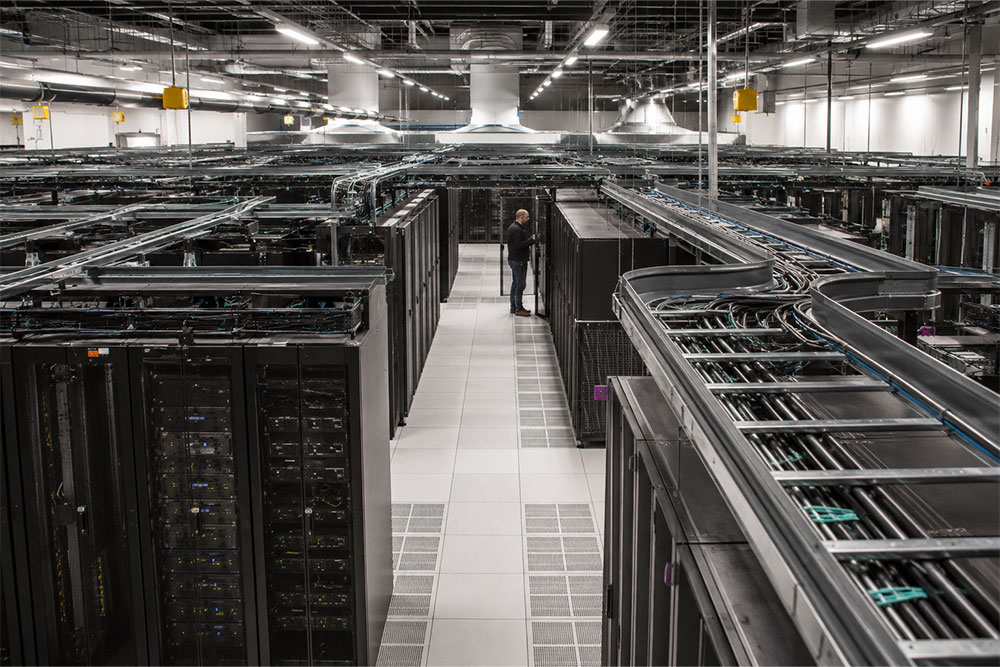
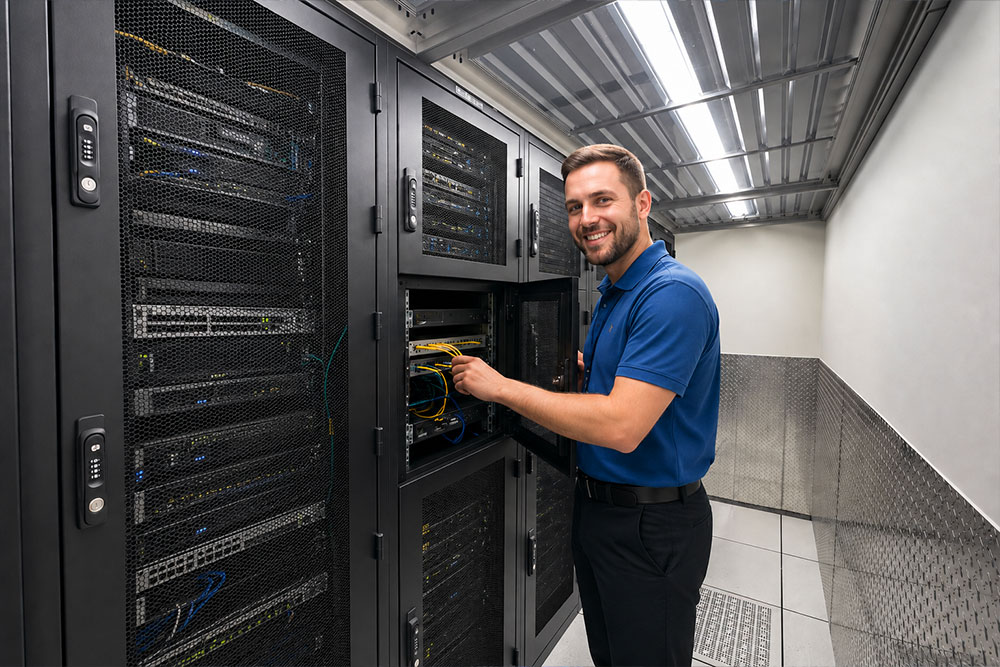
Cross Connect refers to a physical connection between two different devices or networks within the same data center. It typically runs through a patch panel or a network switch. This gives the devices a direct, high-speed connection. Teams often use cross connects to link servers to storage arrays, or to link cloud services within one data center. Cross Connects are typically more reliable and secure than Internet connections, because they avoid the same latency and congestion issues.
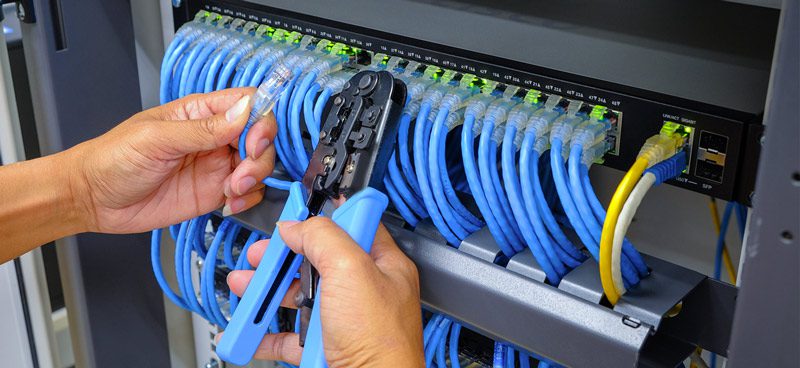
A cross connects involves connecting two termination locations in a data center using a physical, hardwired cord, cable, or jumper.
Why trading partners choose a cross connect
Picture this; Organization A has hosted its servers with Volico Data Centers. It trades with organization B, also co-located in our facility.
To trade and meet contractual agreements, organization A must exchange transactional data with organization B in real-time.
Even though the two trading partners can use a public connection, a cross connect makes more sense.
A cross connection will involve using a hardwired cable to link the two companies’ servers, establishing a dedicated, private connection.
A cross connect is:
- More secure
- Cost-effective
- Reliable
- Efficient
Volico Data Centers cross connect solution delivers superior performance, with reduced latency and top-notch security well above industry standards.
With Volico as your cross connect partner, you can increase your IT system’s performance and enhance traffic flow management.
The ripple effect is that your organization can offer more reliable and consistent experiences than public connections. All this while reducing data loss and ensuring rapid recovery in case of planned or unplanned outages.
In summary, interconnect, direct connect, and cross connect all connect different networks or cloud services. They serve different purposes and suit different contexts. Interconnect links different cloud services in different data centers. Direct Connect links on-premises infrastructure to cloud services. Cross Connect links devices within the same data center.
How MPLS Xconnects and VXLAN technologies are used as data center interconnects, and how do Volico Data Centers utilize them to provide pseudowire equivalents to cross connects?
MPLS Xconnects and VXLAN are both data center interconnect technologies. They enable communication between different data centers or between different segments of a large data center network. MPLS Xconnects provides a Layer 2 (L2) virtual circuit between two endpoints. VXLAN is an overlay network that runs over Layer 3 (L3). It lets you build multiple virtual networks on a shared physical infrastructure.
Volico Data Centers, a cloud and colocation provider, uses these technologies to provide pseudowire equivalents to cross connects. Customers can then connect to their services across different data centers as if they were directly connected. This allows for greater flexibility in network design and can help to reduce costs associated with dedicated cross-connects.
When it comes to choosing between copper and fiber mediums for data center interconnects, there are several factors to consider.
Copper vs fiber for data center interconnects
Copper cabling is generally less expensive than fiber and easier to install and maintain. However, it has limits on distance and bandwidth. Copper cabling typically reaches around 100 meters for 10 Gigabit Ethernet (GbE) connections and 30 meters for 40 GbE connections. However, that may not be enough for large data center networks. Additionally, copper cabling may be more susceptible to electromagnetic interference (EMI) and crosstalk, which can impact performance and reliability.
Fiber, on the other hand, can support much longer distances and higher bandwidths than copper cabling. Single-mode fiber reaches up to 10 kilometers on 10 GbE and up to 40 kilometers on 40 GbE. Multi-mode fiber reaches up to 300 meters on 10 GbE and up to 400 meters on 40 GbE. Fiber is also immune to EMI and crosstalk, making it a more reliable option for high-performance data center networks. However, fiber cabling is typically more expensive than copper and requires specialized equipment for installation and maintenance.
In summary, MPLS Xconnects and VXLAN are both useful for data center interconnects. Volico uses them to provide pseudowire equivalents to cross connects. When choosing between copper and fiber for data center interconnects, consider factors such as distance, bandwidth, performance, reliability, and cost.
VXLAN with EVPN BGP as a Layer 2 interconnect
VXLAN with EVPN BGP (Ethernet VPN with Border Gateway Protocol) creates Layer 2 (L2) overlays. These overlays run over a Layer 3 (L3) network infrastructure. This lets you create virtual L2 networks that span multiple physical locations or data centers. The underlying L3 network, however, handles transport.
To use VXLAN with EVPN BGP as a Layer 2 interconnect, take the following steps:
- Create a VXLAN overlay network: Configure VXLAN tunnels and VTEPs (VXLAN Tunnel End Points) at each site you connect.
- Implement EVPN BGP: EVPN BGP distributes MAC (Media Access Control) address information across the VXLAN overlay network. Hosts in different sites can then communicate as if they were on the same L2 network.
- Configure L2 extension: L2 extension stretches a virtual L2 network across multiple sites. Hosts in different sites can then sit on the same L2 network.
After you complete these steps, hosts in different sites can communicate as if they were on the same L2 network. This is particularly useful for applications that need L2 connectivity. Examples include storage protocols like Fibre Channel over Ethernet (FCoE) and virtual machine migration.
Benefits of VXLAN with EVPN BGP
One advantage of VXLAN with EVPN BGP is that it creates a virtual L2 network across multiple sites. That also removes the need for a dedicated L2 network between sites. This can help to reduce costs and simplify network management.
Another advantage is that VXLAN with EVPN BGP scales well for L2 interconnect. It supports a large number of virtual networks and expands easily as needed. It also gives you flexibility in network design, because you can create, modify, or remove virtual L2 networks as needed.
Overall, VXLAN with EVPN BGP is a powerful technology for creating virtual L2 networks across multiple sites. It gives you a scalable and flexible solution for L2 interconnect.
Are You Ready to Get Started with Volico Data Centers Connectivity Solutions?
High-quality connectivity and collaboration are essential growth elements in a world leaning toward digital transformation.
Interconnection with Volico Data Centers enables your organization or business to leverage a hyperconnected data exchange ecosystem. It also enables you to take advantage of reduced costs, low latency, and enhanced security.
Whether you need interconnect, direct connect, or cross connect, Volico helps you get the most from your IT infrastructure.
Volico is a carrier neutral interconnection data center with data centers in Miami, Fort Lauderdale, Atlanta, and Chicago.
What Next?
Volico Data Centers is out to simplify interconnection.
We seek to deliver next-level interconnect, direct connect, and cross connect solutions that support your network and business requirements.
Volico offers solutions for leasing dark fiber or using Wavelength Division Multiplexing (WDM) technology. They increase your business’s capacity to network across multiple locations and anywhere in the world.
Volico Data Center interconnection solution promise:
- Better traffic flow management
- Speedy disaster discovery
- Reduce latency
- Global networking
If you have questions about Volico Data Centers interconnect, direct connect, and cross connect, we’ll gladly answer them.
Reach out to us as follows:
Call: or Chat with one of our interconnection experts to discuss which solution best suits your business needs.