Data storage and processing needs are growing at an unprecedented pace. As a result, businesses increasingly look for solutions that can efficiently meet those needs and promote their growth. This search often concludes with colocation, because it offers flexibility and scalability that small businesses and large enterprises can both use. Technology keeps evolving, and data center power demand keeps growing globally. So colocation power considerations sit at the top of the checklist for businesses choosing this solution.
So, how will your team know whether your prospective colocation data center has everything to fulfill your power needs? To make sure that you’re choosing the right provider, your team should carefully examine a few essential things. When gathering information, cover power considerations first. They show whether your chosen provider can meet your present and future power needs.
This blog unpacks the power-related questions you might want to discuss with your soon-to-be provider.
Essential Colocation Power Considerations
When choosing a colocation provider, carefully considering power needs is crucial for your long-term stability and growth. A detailed evaluation helps find providers who have the means and expertise to meet your current and future growth. Reliable power infrastructure reduces the risk of downtime. A provider with strong power management and backup systems can keep you operational even during an outage. Making sure that the provider offers scalable power solutions allows your business to adapt easily, without hindrances. Handling power density and distribution helps avoid failures and keep costs in check, while sustainable energy practices can support your business’s green goals.
Discussing these colocation power considerations with your provider can be crucial. Let’s take a look at them in more detail.
Redundancy and Reliability
When making important decisions regarding your infrastructure, redundancy is among the first and most crucial colocation power considerations. Every organization has slightly or significantly different power requirements. Because of this, businesses need to understand data center redundancy when designing their infrastructure.
The easiest way to grasp redundancy is the concept of N. N represents the minimum infrastructure needed to run a data center at full capacity. For example, if four UPS units are required, N equals four. This logic further applies to cooling, networking, and storage systems. The lowest redundancy level is N+1, meaning that there is a failover component beyond the minimum. N+2 provides two extra components. 2N represents 100% redundancy, meaning that there’s an identical backup for each required component. So, if N equals 4 UPS units, 2N means having eight units. The most extensive architecture is a 2N+1, which offers a complete backup for each component, plus an extra component.
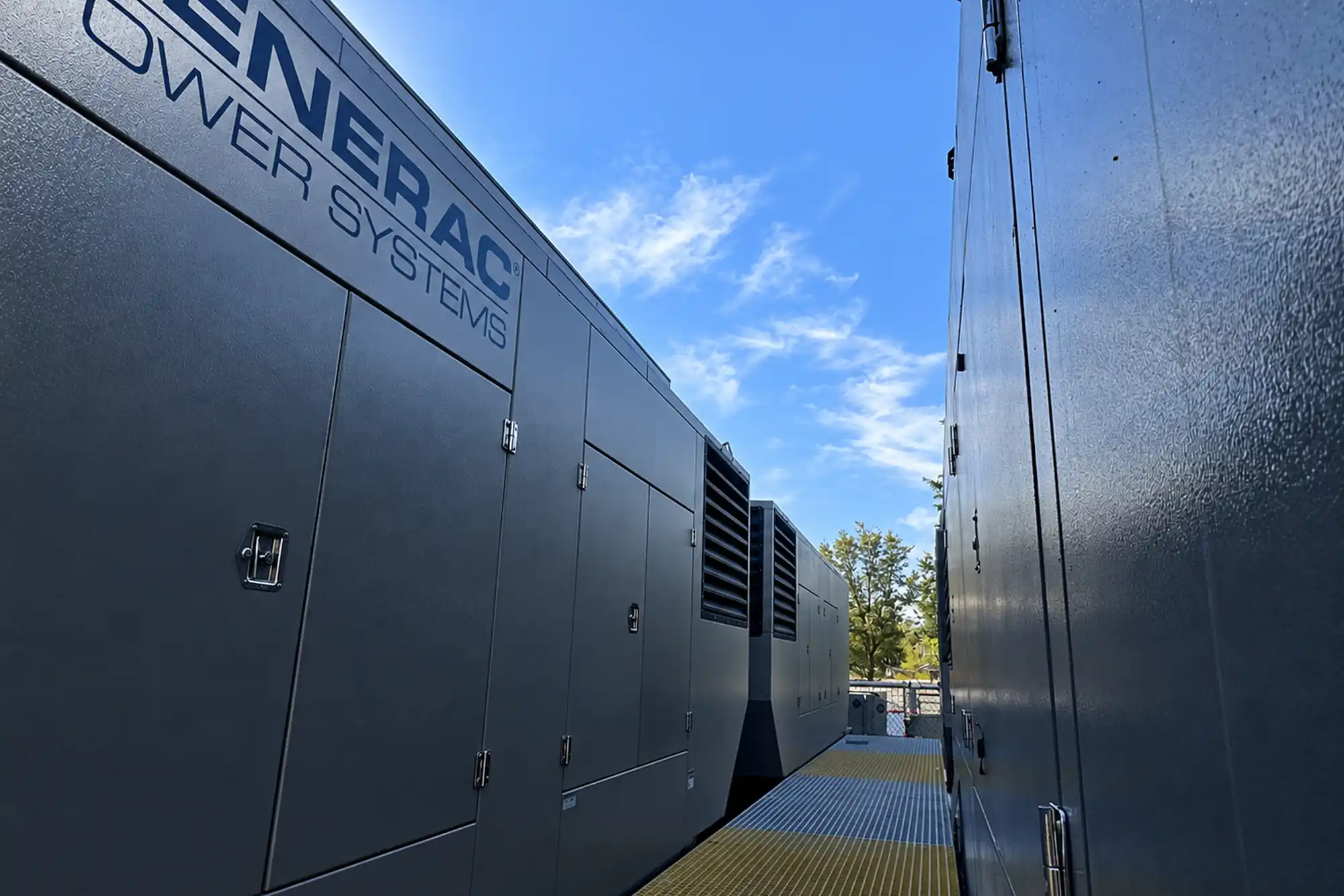
As for reliability, any power disruption can lead to downtime and significant financial impacts. A highly reliable data center minimizes these risks by providing multiple power sources, backup generators, and UPSs. As a result, the risk of going down during a power outage or failure shrinks. It’s crucial to ask a possible future provider whether they have the power redundancy measures to safeguard your operations.
Scalability
A key aspect of colocation power considerations is ensuring that scalable power options are available to accommodate growing needs. Choose a colocation provider that can provision additional power when needed. That approach meets your company’s current and future needs. Scalable power options enable data centers to support growth seamlessly without bigger disruptions and expensive changes to the infrastructure.
Maybe the biggest advantage of colocation is its easy scalability. You can pay only for what you need at any given time. When taking a data center tour, ask whether the provider offers modular power solutions and advanced power management systems. Both should adjust easily to meet evolving needs.
Power Density and Allocation
Power density refers to the amount of power the data center delivers per square foot. Higher power densities make it possible to operate more servers and equipment on a smaller footprint. Allocation involves distributing the power efficiently to racks and equipment, making sure that no single area is overloaded. Power density and allocation are critical colocation power considerations, as every business has different power density requirements. While some require moderate power levels, others need high density for compute-intensive applications. Your provider has to balance power density and allocation to maximize space utilization and maintain reliability. This requires a good understanding of density requirements and careful planning. Planning should balance power allocation for your needs, leaving no room for failures.
Sustainability and Energy-Efficiency
As power demand continues to grow at a mind-blowing rate, sustainability has become a key aspect of corporate responsibility. But sustainable energy sourcing and data center management practices reduce the carbon footprint and environmental impact of facilities. They can also significantly reduce costs. Because of this, most organizations today set goals around reducing their carbon footprint and looking for ways to use more renewables.
The PUE or power usage effectiveness is a key metric here. It measures the ratio between the total power entering the data center and the power actually used by computing equipment. Higher PUE values indicate more energy is spent on non-computing functions like cooling. A low PUE is ideal, as it shows that energy is well-managed and waste is minimized. Choosing providers with strong PUE scores can help companies better meet their sustainability goals. It also keeps costs under control.
Tools and Services Provided
The tools and services a colocation provider offers play a key role in effective power management. Real-time monitoring and control help businesses track power usage and plan for future needs. They also prevent issues that could lead to downtime. Before making a decision, make sure to inquire providers about offering services like remote troubleshooting, managed backup, and VPN support. These tools can help manage your infrastructure efficiently. They also allow custom configurations that fit specific needs. As a result, companies can optimize power efficiency, maintain uptime, and strengthen their infrastructure’s resilience.
Transparency and Tailor-Made Services From Volico
To make the best decision on all crucial colocation power considerations, you need a transparent provider like Volico Data Centers. Our powerful monitoring tools help track power consumption, plan for future needs, and anticipate potential issues. But Volico goes beyond the standard. It offers extensive managed services and works closely with clients to understand unique business needs and deliver customized solutions. From infrastructure as a service (IAAS) to application and even kernel-level support, Volico tailors its services to each client’s specific needs. For redundancy and reliability, Volico’s 3rd Generation Data Center features 2N+X SmartGrid redundant power and cooling infrastructure. This design ensures uptime for your data and IT assets.
With a dedicated team, Volico ensures your business receives the expert support it needs. As a trusted leader in data center management, Volico supports companies in optimizing power efficiency and maintaining uptime. It also strengthens their overall infrastructure resilience for sustainable business growth.
If you’d like to take a look around our facilities, take our 360°virtual tour! If you’d like to learn more about what Volico offers and how we can help sustain your power needs, feel free to contact us.