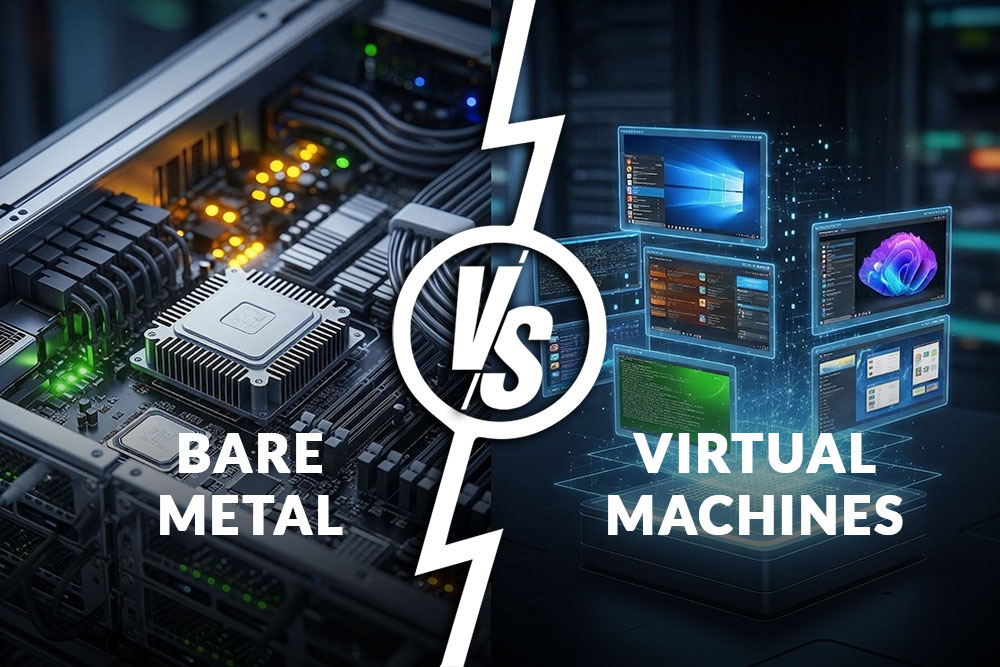
Bare metal vs. virtual machines has become a recurring topic in infrastructure strategy discussions. Organizations increasingly rethink how they deploy workloads across modern IT environments. Over the past two decades, virtualization has transformed the way companies run applications. Industry estimates suggest that over 90% of enterprises now use some form of server virtualization. It allows multiple operating system environments to run on a single physical machine, which dramatically improves hardware utilization.
That widespread adoption makes sense. Virtual machines have many advantages. They let teams consolidate workloads and deploy environments quickly. Teams can also scale infrastructure without new hardware every time demand changes. In many enterprise data centers, a single host runs several virtual machines at once. It distributes CPU and memory resources across multiple applications.
However, the limitations of shared infrastructure are becoming clearer as workloads grow more demanding. Performance-sensitive applications, high-throughput databases, and advanced analytics systems increasingly require direct access to hardware resources. They need CPU, memory bandwidth, and storage throughput on demand. They also want more granular control over how they allocate resources.
The choice between bare metal vs virtual machines plays a significant role in infrastructure planning. This blog explores both deployment models to help you decide which one best supports your workloads.
Why the Choice of Deployment Model Matters
When people talk about deployment models, they are really talking about where your applications live. They are also talking about who runs the infrastructure behind them. In many cases, the conversation centers on bare metal vs virtual machines. That means deciding whether workloads run directly on dedicated hardware or inside virtualized environments. That decision shapes a lot more than most companies expect. From a business perspective, the deployment model affects your cost predictability and your control over systems. It also determines how easily your infrastructure evolves as the company grows.
Take cost, for example. If everything runs on-premises, the organization usually invests heavily upfront in hardware and maintenance. That works well for stable workloads where demand is easy to forecast. Virtualized environments, on the other hand, bring a different mix of pros and cons. Instead of dedicating an entire server to one workload, companies allocate resources through virtualization. That flexibility can be attractive. However, it requires careful monitoring, because inefficient allocation can still raise operational costs.
Performance, Security, and Long-Term Flexibility
Applications that depend on fast data movement benefit from infrastructure close to major network hubs and interconnection points. In those cases, companies may want to place infrastructure in colocation facilities near dense carrier ecosystems. Performance drives many deployment decisions, including choices around bare metal vs. virtual machines. Proximity to carriers supports it by reducing latency and improving reliability.
Organizations under strict regulatory frameworks need clear visibility into how they configure systems and where they store data. Security and compliance are non-negotiable for these businesses. The right deployment model, whether dedicated hardware or virtualized infrastructure, makes it easier to maintain that control.
Flexibility matters too. As new applications appear and workloads grow, priorities change. Most of the time, businesses can’t keep the same infrastructure requirements for long. The deployment model determines how easily the IT environment adapts when those shifts happen.
Understanding the Difference Between Bare Metal vs Virtual Machines
What Is Bare Metal?
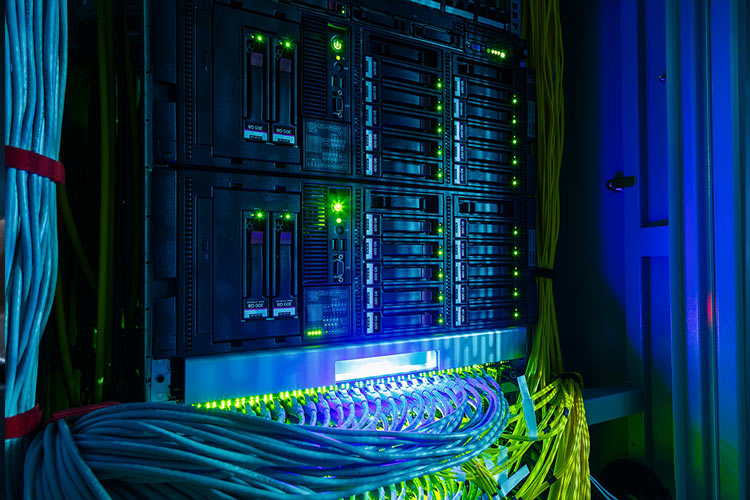
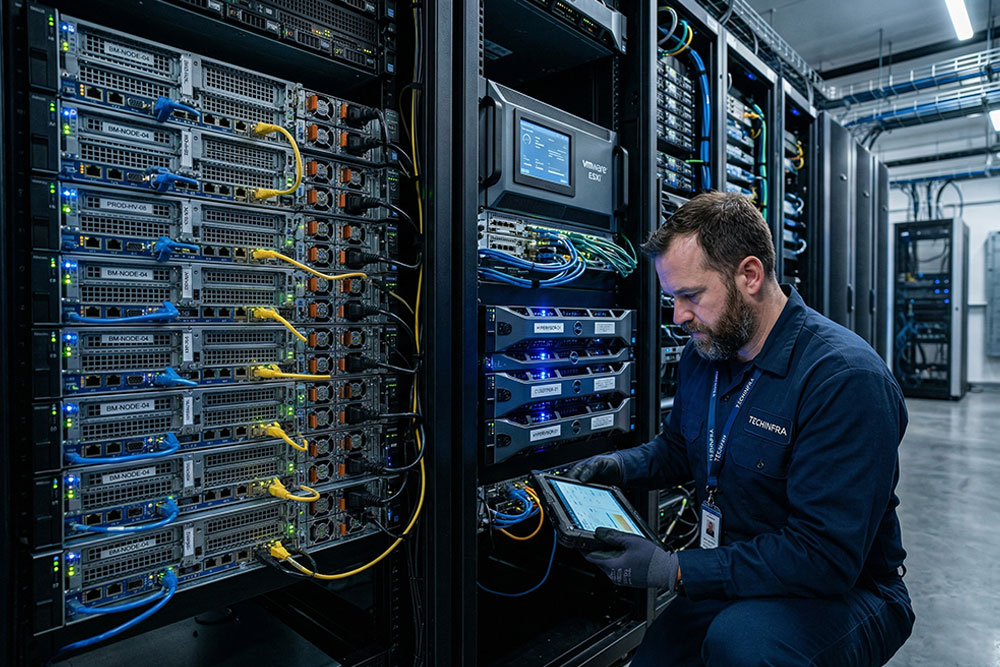
If you trace a workload down to the machine it runs on, bare metal is the simplest possible arrangement. The operating system sits directly on the physical server. It interacts with the hardware itself, without any virtualization layer in between. The application stack uses the CPU, memory, and storage exactly as the machine provides them. As a result, the machine serves one tenant or one workload environment.
The direct relationship with the hardware gives bare metal servers their reputation for predictable performance. No hypervisor redistributes resources across multiple environments. The machine also doesn’t have to balance neighboring workloads that compete for compute capacity. A bare metal deployment means one operating system environment controls the entire server. The infrastructure therefore behaves the way the underlying hardware allows. In the bare metal vs virtual machines discussion, direct hardware access is often the defining characteristic.
What Are Virtual Machines?
Modern infrastructure tries to make better use of physical hardware, and virtual machines follow that idea. One server can host several independent environments by dividing its resources through virtualization. Instead of dedicating an entire machine to a single operating system, VMs share the hardware across multiple isolated systems. Each one behaves like a separate server. A hypervisor handles the separation. It sits between the hardware and the operating systems. It distributes CPU capacity, memory, and storage across the virtual machines on the host. Each VM has its own operating system and application stack. From the software’s perspective, it feels like a fully independent server.
Bare metal’s strength is direct hardware access and stable performance. The biggest advantage of virtual machines is flexibility. In conversations about bare metal vs virtual machines, this flexibility is usually the central argument. Once you virtualize infrastructure, teams can create new environments quickly. Workloads can move between hosts, and resources can shift as demand changes.
Things to Consider Before Choosing a Deployment Model
Once you evaluate infrastructure seriously, the question of bare metal vs virtual machines becomes a practical exercise. You need to understand how your workloads actually behave. The right deployment model shouldn’t be an abstract preference. It should be a conscious choice based on three questions. How do specific applications consume compute resources? Is their demand predictable? And how much operational control does your team need? Consider these before making a choice:
Performance Needs
Application performance depends on how workloads consume CPU power, memory capacity, storage throughput, and network bandwidth. Systems with heavy compute requirements or very high I/O activity typically benefit from stable access to hardware resources. Bare metal environments provide direct access to physical resources, which can improve consistency for demanding workloads. Virtual machines, on the other hand, add a software layer that manages resource allocation across multiple environments.
Security
Security requirements can shape deployment decisions just as strongly as performance expectations. Organizations under strict compliance frameworks need detailed visibility into system configuration, data storage, and workload isolation. Since different deployment models offer different levels of control over the underlying environment, infrastructure architecture plays an important role here.
Scalability Potential
Workload demand is inherently inconsistent. Some applications grow gradually over time, while others experience sudden spikes that require additional compute capacity.
Virtualized environments can simplify scaling because teams can redistribute resources or create new environments as needed. Dedicated hardware environments expand differently, typically by adding new servers to the infrastructure.
Resource Management
After teams deploy infrastructure, they still need clear visibility into how the environment uses resources. Monitoring CPU utilization, memory allocation, storage consumption, and network bandwidth becomes essential for avoiding waste and maintaining stable performance.
Virtualized environments can redistribute resources dynamically, while bare metal environments rely more on careful capacity planning.
Control
Infrastructure decisions also influence how much control administrators maintain over workloads and data. Some organizations require granular oversight of system configuration, operating environments, and access policies. In practice, bare metal vs virtual machines often comes down to how much direct control teams want.
Lifecycle Sustainability
Infrastructure planning doesn’t stop after deployment. Teams must update servers, workloads evolve, and software environments change over time.
The long-term sustainability of an infrastructure model depends on how easily teams can maintain, update, and adapt systems. Technology requirements never stop shifting.
Single – or Multi-Tenant?
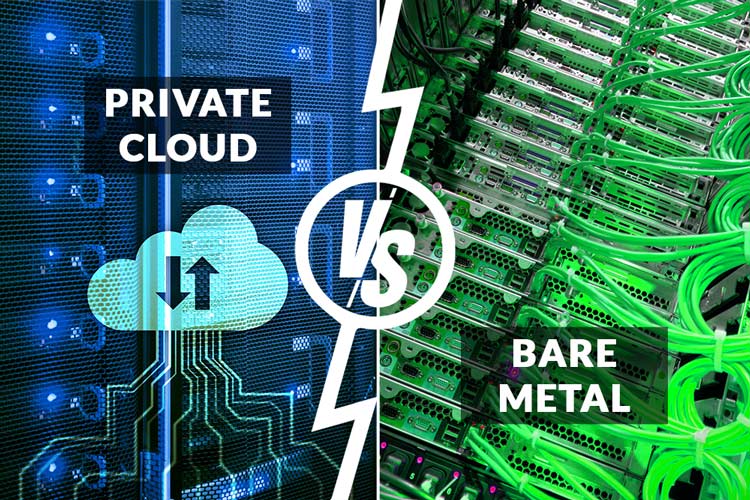
In infrastructure architecture, tenancy describes how providers separate computing environments between organizations. It also covers dedicated resources for one user versus shared resources across multiple workloads. This distinction matters a great deal in infrastructure decisions. It often appears in discussions about bare metal vs virtual machines. The reason is simple: the way a provider allocates hardware directly affects performance, control, and security.
A single-tenant environment dedicates the infrastructure to a single organization, whether that’s a physical server or a software instance. The hardware and operating environment belong entirely to that tenant. This gives teams full control over configuration, security policies, and performance characteristics. This setup fits organizations running sensitive workloads or systems that require very predictable performance. Because the tenant doesn’t share the infrastructure, no neighboring environments compete for resources. Admins can also tailor the system exactly to the needs of the application.
With a multi-tenant model, on the other hand, multiple customers or workloads use the same infrastructure. They stay logically isolated from one another. Virtualized environments and cloud platforms work this way because it uses hardware resources more efficiently and makes scaling much easier.
Choosing between the two, of course, comes down to priorities. The single-tenant vs multi-tenant discussion reflects a broader comparison between control and efficiency. That is also why the topic frequently appears in conversations about bare metal vs virtual machines. Many organizations end up using both models for different workloads, depending on their requirements.
Bare Metal vs Virtual Machines: Key Differences for Infrastructure Planning
Infrastructure teams usually start with the operational realities of their workloads when they weigh bare metal vs virtual machines. Some applications need direct, predictable access to hardware resources. Others benefit from environments that teams can provision and adjust quickly as demand changes. Through that lens, the comparison comes down to a handful of practical considerations.
Tenancy
Tenancy is usually the first distinction infrastructure engineers mention, because it shapes how workloads share hardware resources. In a bare metal deployment, the provider allocates the entire physical server to a single customer or application environment. The machine therefore operates as a single-tenant system, with no neighboring workloads competing for resources. That eliminates what operators sometimes call the “noisy neighbor” effect.
Virtual machines offer a different model. Multiple operating system environments run on the same physical host. Each behaves like an independent server, even though they share the underlying hardware.
Security
Security considerations build directly on that tenancy structure, because workload isolation determines how you protect systems. Bare metal environments give administrators full control over the server itself. Teams can deploy custom security software and configure protection at every layer of the stack.
Virtual machine environments rely on logical isolation that the hypervisor manages. The architecture is widely used and generally secure. However, organizations don’t control the physical host when they share infrastructure. That difference can influence how teams evaluate risk in sensitive environments.
Performance
Bare metal servers give applications direct access to the machine’s CPU, memory, and storage subsystems. Applications can therefore use the full capacity of the hardware.
Virtual machines operate differently. Multiple environments share the hardware, and a hypervisor manages it, so compute resources may shift dynamically across workloads. In most situations, the impact is small, but highly demanding applications can benefit more from dedicated hardware.
Customizability
Customization is another area where bare metal vs virtual machines differ. Here, dedicated infrastructure stands out. Bare metal systems let administrators modify operating systems, tune storage configurations, and upgrade components to match specific workloads.
Virtual machines are configurable as well, but they don’t provide the same level of control over the underlying hardware. Adjustments can happen within the virtualization platform, but not at the machine level.
Scalability
Scalability favors virtualized environments because teams can create new instances in an instant as demand increases. They can deploy additional VMs within minutes, which expands capacity with relatively little operational friction.
Expanding capacity with bare metal servers means provisioning additional physical servers. That takes more time, planning, and investment.
Pricing
Pricing models reflect the way these systems allocate resources. Bare metal servers usually come with predictable monthly costs, because a single tenant reserves the entire machine.
Virtual machines follow a usage-based model. Costs change depending on how much compute capacity, memory, or storage the environment consumes.
Maintenance
Maintenance responsibilities also differ between the two approaches. That operational difference is one reason bare metal vs virtual machines keeps coming up in infrastructure planning conversations.
Bare metal infrastructure almost always requires direct attention to hardware lifecycle tasks. However, many providers include hardware support as part of the service.
Virtual machine environments reduce that responsibility because the infrastructure provider manages the physical servers and the virtualization layer.
Bare Metal vs Virtual Machines for High-Performance Workloads
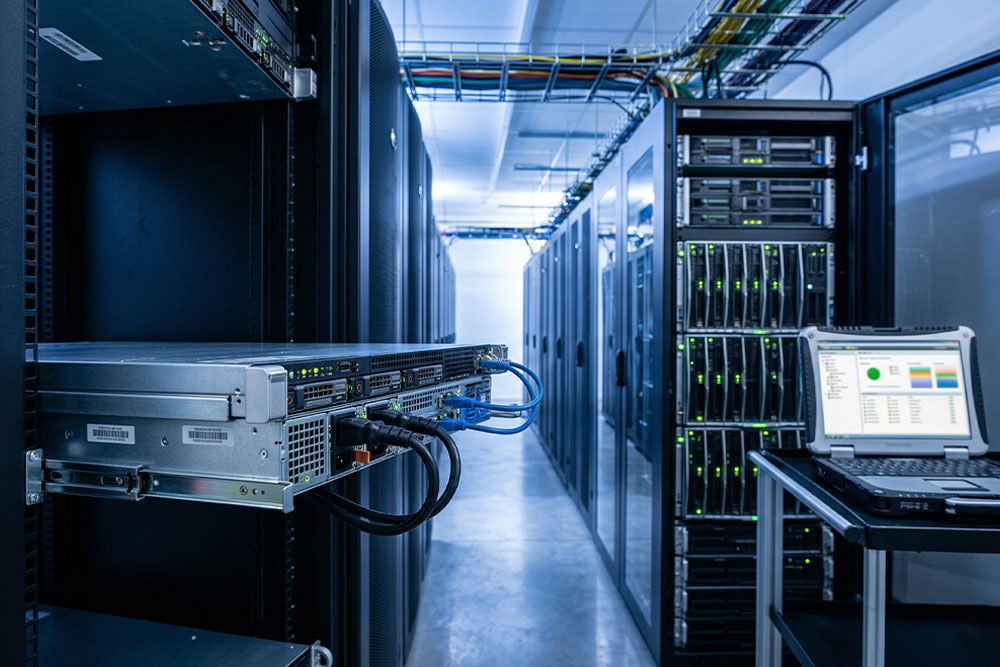
Some workloads push infrastructure to its limits. For those, the conversation about bare metal vs virtual machines becomes more concrete. Applications that process large volumes of data or support latency-sensitive services tend to benefit from fully dedicated resources. That makes bare metal infrastructure stand out. Because the operating system runs directly on the server, no virtualization layer redistributes resources. Workloads get predictable access to CPU power, memory, and storage throughput. The environment behaves exactly the way the hardware’s designers intended.
Volico Data Center designed its hardware and software options with those kinds of workloads in mind. Volico can deploy servers with the operating system and configuration that best fit your application stack. Its carrier-neutral data centers also provide strong connectivity and stable infrastructure conditions for performance-sensitive environments.
With Volico bare metal, organizations gain access to:
- Full control over the underlying hardware environment
- Dedicated infrastructure without noisy neighbors
- High-capacity connectivity through carrier-neutral facilities
- Secure data center environments with monitored physical access
- Around-the-clock operational support from experienced infrastructure teams
If you’re evaluating how dedicated infrastructure could support high-performance workloads, Volico’s team can help. They will walk through your requirements and discuss how bare metal deployments fit into your broader IT strategy.
Contact us today to learn more.